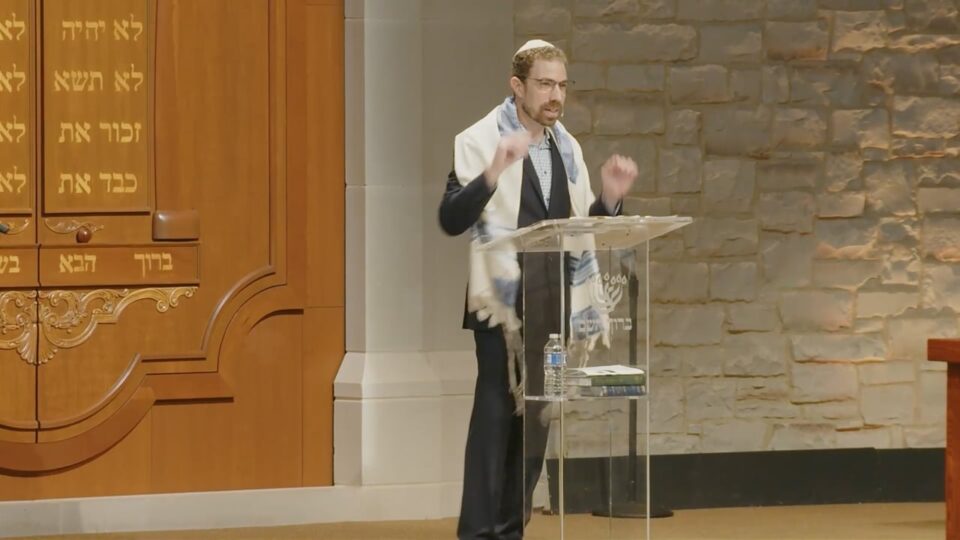

Message
Rabbi Shawn Moir•Deut. 21:10-21•August 26, 2023
Timestamps seek whichever format is playing — video or audio.
0:00 This time I'd like to invite Rabbi Sean more up to the stage to the platform so I can pray for him. Father, we just come to you just thanking you that you have called Rabbi Sean on this particular day to deliver this message that you have put on his heart. Father, we pray that you would work in him both to will and to do your good pleasure that you would give him the courage, the compassion, the conviction to preach your word boldly and with great confidence knowing that it is your word and through your word. We have life in the mighty name of Yeshu we pray.
0:48 Amen. Amen. Thank you, Marcus. We will be in Leviticus. No, we won't. We'll be in Deuteronomy, um, chapter 21 verses 10 through 21 today. If you wanna turn there, We have little control over the hand that we are dealt in life. We are born into a particular family in a particular place in the world at a particular time, and we have no control over this.
1:34 We have no control concerning the community that we are born into or even the faith of our ancestors. We cannot control whether our forebearers are heroes or villains. As we grow, we begin to have stewardship over certain things. This may give us the illusion of control, but we are still at the mercy of our environment. There is a particular cultural climate in which we are raised that comes with its own strengths and weaknesses, dangers and opportunities. The era that we are born into factors greatly into what our
2:21 life will be like. Historical events, local laws, economic realities and weather phenomena all shape. Our worldview and the person that we become, The people in our lives have a significant impact upon the development of our character. Perhaps we wanna be more like them or less like them. While our choices can help to shape our character, we have little control over which temptations we face and to what extent we face them. The family that we are born into will impact our genetic makeup and our tendencies. Our local context forces us to face issues that others
3:11 may know nothing about yet. In this complicated reality, we see the fingerprints of a master orchestrating the details. We see the beauty of creation. We see the aspects of the creator in those around us. We have been given gifts even if we fig haven't yet figured out how to apply those gifts. As we grow, we gain an understanding of the importance of our choices, both small and great. While we have been dealt a particular hand, we have some level of autonomy in choosing how we utilize these cards that we have been dealt.
3:58 While we may wish to control the world, it is clear that we struggle with the small sliver of the garden that we have been given. We need help from on high and we need help from our community. Looking back, I realized that one of the formative factors in my life is that I was born colorblind. Don't feel sorry for me. I see colors too. I just see them differently from everyone else and I'm not suffering by being colorblind. However, I do realize that it has shaped my life in some way. Most significantly, when I was younger, I received my pilot's license. However,
4:46 due to my colorblindness, I could not fly solo at night. I had aspired to be the pilot of a blimp, but my condition made that path nearly impossible. I began considering other options and developed an interest in air traffic control. I even worked as an intern for the F A A in the tower and the New York Center. I was well received by the staff and the head of the New York Center made a personal appeal to me. When I informed him of my colorblindness, he had me sent to a facility at Kennedy Airport where they had state-of-the-art testing equipment. Sure enough, they confirmed what I had known since kindergarten. I was colorblind,
5:32 so was my grandfather. It was no surprise. Thankfully as a child, all the crayons said what color they were on the wrapper and I was able to get through most of my assignments just fine. Even with this colorblindness diagnosis, the air traffic control industry was willing to try and find a place for me. However, through working as an intern, I understood the danger that came with my condition in that environment. Even though I may only see things slightly different from others, that subtle difference could be the thing that keeps two planes from colliding in the air. I had seen enough to know that the job was high pressure on its own.
6:19 It was clear to me that it would not be advantageous for me to pursue this path. This is when I went for my third choice in the field airport management and I pursued my degree. It was during my studies in airport management that I met my wife and had an encounter with the Lord that changed my outlook and ultimately the direction of my life and I had very little control over any of this. Although I had this colorblindness, I was grateful that I had something else to compensate for it. My vision was razor sharp when my eyes would be tested, I could read the finest print with ease while driving, I could read signs from far distances.
7:05 It is as if I had been given a superpower to compensate for an area of weakness. However, around the time I hit 40, I noticed that the world around me was changing. Everything wasn't as crisp as it used to be. The air was foggier these days. The sun was harsher. The fine print was smaller than ever. The eye doctor confirmed that my sharp vision was no longer what it used to be. I was prescribed lenses to help, but that sharpness that I had grown accustomed to was no longer available. Even with the glasses, perhaps you have been in the optometrist chair yourself. You are shown images and asked which one is clearer.
7:54 Hopefully a lens is available that will allow you to see the world distinctly. This week's Torah portion T say begins with three scenarios that may appear blurry to North Americans in 2023. For instance, last year alone our national military spending was $877 billion. This is the highest military budget in the world and probably in world history. However, less than one half of a percent of our population serves in the US military. Very few people in the room can relate to the realities of military warfare.
8:41 Even for those who are presently serving or who have served, their experience would likely be far different from what is described in the Torah. If you are presently in possession of captives and do not know what to do with them, please see one of our kind officers immediately. Next, the Torah shows us a different picture where a man has two wives and must make decisions concerning which wives, firstborn son receives the double portion. Again, there are likely and hopefully very few people in the room who can relate.
9:28 Thirdly, there is an account of a stubborn and rebellious son. The parents are instructed in the procedure which results in the sun being stoned to death by the men of the city. I search long and hard through our community calendar for the coming months and I have seen no mention of a community stoning. Is any of this relevant to modern life and faith? How can we clearly see God's instruction in these seemingly archaic examples? In this week's Torah portion, The title of my message is Finding the Appropriate Lens.
10:14 It comes from d Deuteronomy 21 verses 10 through 21. In spite of how crazy or blurry these examples may seem, I believe that God is giving us clear guidance that can be applied in our lives today. You could even see how these three episodes could feed one could feed into one another in context with a captive wife leading to favoritism and then leading to a rebellious child. I would like to demonstrate three principles from this passage. First, God is calling us men to control our impulses and women to live with dignity. Second, God wants us to avoid favoritism in our family
11:02 and thirdly, God wants us to tend the needs of our family before it becomes a community dilemma. Ultimately, I believe that God is teaching us that he wants us to respect him and his children. My outline can be found on the YouVersion app and I will be reading from the Tree of Life version. Do Deuteronomy 21 verses 10 through 14 read as follows. When you go out to war against your enemies and Adonai your God, hands them over to you and you take them captive. Suppose you see among the captives a beautiful woman and you
11:48 desire her and would take her as a wife for yourself, then you are to bring her into your house and she must shave her head, trim her nails and remove her captive's clothing. Then sit in your house and weep for her father and mother a full month. After that, you may go to her and become her husband and she will be your wife. Now, if you are not pleased with her, then you may send her off wherever she wishes, but you must certainly not sell her for silver. You may not treat her as merchandise since you have humiliated her.
12:36 God is calling us men to control our impulses and women to live with dignity. Let me begin on this point with addressing the Torah in context. It begins with when you go to war. So to begin, we must understand that this instruction is given for a specific context. Not only is this instruction given in the context of war, but it also has a second stipulation. In this particular war scenario, God hands over the enemy and Israel has taken the enemy captive. It gets even more specific describing a situation where there is a
13:23 beautiful woman among the captives that a man wishes to take as his wife. So it must be understood that we are dealing with a code of conduct for warfare. Have you ever been put into a place of vulnerability? I have. Typically, I have found myself in vulnerable places as a result of my own stupidity. However, this scenario is far different. Here in the Torah, God shows concern for the females of the nations who are at war with Israel. Their men have been defeated, they have become captives. These women are created in the image of God and they are to be treated with
14:10 dignity. A woman today needs to be aware of the dangers of our society. Perhaps you're packing pepper spray or something even more fierce in most contexts. If you are feeling threatened in any regard, there is action that you can take. There may be those that you can speak to or authorities that you can call upon In this situation in the Torah, these women are in the most vulnerable place as they have access to none of the protections that many of you have today. God is instructing the men to control their impulses and for the women
14:55 to be treated with dignity. We must also understand that in this situation, lives are at stake. If a woman has lost her family and all sense of protection, her best option may be to make an appeal to her captors. She may try to present herself in the most beautiful way possible in order to save her own life and in order to find security. It is a risky and desperate situation. God does not allow his people to take advantage of this situation and to take advantage of vulnerable people.
15:41 While I am not qualified to speak from a female perspective, I can certainly understand God's guidance to men. Last week, driving home from the Shabbat service, the kids and I witnessed a house fire in Richardson. If any of you were driving towards 75 after service, perhaps you saw it too. Did anyone see that It was difficult to miss if you were driving in that direction. It was a large pillar of thick smoke. Imagining the chaos and destruction that such a house fire causes, one might be tempted to despise fire. The larger that a fire grows, the more difficult that it is to control and the more destruction which that
16:30 fire can bring. However, for those of you who have been around for a while, there is this thing called winter. It is a strange phenomenon where it is about a hundred degrees cooler outside and things actually begin to freeze and it can become so extreme that pipes burst and trees and power lines come down from the weight of the ice and the force of the wind. And if you should find yourself in a situation where you have no access to electricity in your homes, you will be most grateful for a fire to keep you warm and fed.
17:16 The sexual impulse is a lot like fire. If it is uncontrolled, it can destroy lives and homes. It can lead us to great destruction and devastation. However, if it is controlled and used properly according to the Lord's guidance, it becomes union with our spouse and the means to become co-creators of life with the Lord himself. I came to faith when I was 20 years old. It was immediately apparent that I needed to become a firefighter, so to speak. I did get married five months after coming to faith as Raha UL
18:01 says, it is better to marry than to burn. However, as a young married believer, I was shocked by how difficult it was to control this impulse. During my first year of seminary, I sought out the oldest male professor I could find. I made appointment with him and I asked him when the impulse goes away so that we can get on with serving the Lord. When he was done laughing, he told me, Sean, I have some difficult news for you. It does not go away during your lifetime. Dr. McGee has gone on to be with the Lord, but about 20 years later,
18:49 I recognize the truth of his words. In this wartime scenario, the Israelite male was not permitted to act upon his impulse. Rather, he had to begin by protecting her. He had to take her into his house immediately. Her primary need for protection would be met. If you've ever taken someone into your house, you'll understand that this is not a simple thing. Cultures collide. Habits differ. How does the household feel about this new person? How does she feel about them? What are the differences of faith and practice?
19:35 All of these things become issues when we share a home, don't they? This also implies that her material needs would be met and it's actually quite a responsibility. Furthermore, she is to shave her head, so God is saying, you want this woman to be your wife. You are captivated by her beauty. The next step is to completely change her appearance. It is a test concerning a man's motives for making her his wife. Does he still desire her if she completely changes her appearance? As an aside, anyone who has been married for a long time will need to face the reality
20:23 that the person we married has changed since we met them. We also have changed. The key is to process these changes together in order to find contentment with one another as the seasons of life change, and it's not always easy, but let's get back to the text. Next she is to trim her nails and get new clothes. Then she is to sit in your house and mourn for what she has lost for an entire month. This is similar to Jewish mourning rituals of course, and this is really a test for both parties.
21:10 The Israelite man must recognize the humanity and dignity of the woman. He and his family will have plenty of time to consider this addition to the household. Additionally, this woman will be having her own thoughts during this month, which will surely affect the outcome of this relationship, and it was only after this season that a man was permitted to consummate the marriage at this point if he was not pleased with her, and the implication is also if she's not pleased with him 'cause that becomes very difficult. She could also be released to wherever she wishes she was not to be bought or sold or treated as merchandise.
21:57 Since the man has humiliated her, he's taken away her family, he's taken away her dignity, and now he's releasing her. I understand that this might seem extreme through modern eyes. However, consider that this is how God is showing concern for the enemies of his people, the enemies of Israel. He is concerned about the welfare of one who has fallen into unfortunate circumstances and a place of vulnerability. So men, God is calling us to control our impulses.
22:42 Pretending that we don't have them is not an effective plan. Rather, we must be honest with ourselves, our God, who we can't hide anything from anyway, our spouse, hopefully singular spouse. If you have one and our trusted friends, men, we must help one another to face the temptations which we all share. Women, please understand the dangers of our society. This world is not safe. People, especially men, will seek to exploit you because of their impulses. Don't be fooled into thinking that it can't happen among believers or even
23:29 leaders that you trust. Yeshua was the only one who walked without sin. The rest of us are mixed bags engaged in a battle between spirit and flesh. The good impulse and the evil impulse. Understand your value and dignity. Your body is not a product. The man who you choose should honor you and protect you. You are created in the image of God and deserve to be treated as such by yourself and by others. De Uh, Deuteronomy 21 verses 15 through 17 Read,
24:16 suppose a man has two wives, the one loved and the other unloved, and both the loved and the unloved bear him sons, but it happens that the firstborn son belongs to the unloved wife. Now on the day he lets his sons inherit what he has, he must not treat the loved one's son as firstborn in place on the of unloved. One son who is the firstborn. Rather, he must acknowledge the firstborn, the son of the hated one. By giving him a double portion of all that he has for he is the first of his vigor, the right of the firstborn is his
25:09 Avoid favoritism within your family. Hey guys, don't you hate it when there is friction between your favorite wife and your other wives? Isn't it hard when the families of your various women don't get along? I've got a couple wives now isn't that big of me? Joking aside, if you've spent any time reading scripture, you will know that God's prescription is for a husband to have one wife and to be faithful to her. In fact, just a few chapters earlier in Deuteronomy chapter 17, verse 17,
25:57 God says that a king should not multiply wives. The king should not have multiple wives and neither should the people of Israel and neither should we. This became the downfall of King Solomon. Each time we see accounts in scripture of polygamy, there are myriad problems that come with this. As modern readers, we might switch our lenses for a moment to consider the vulnerability of women in this context and we may have a more sympathetic perspective. However, even in that time, polygamy came with consequence. Here we have just one example of a consequence.
26:43 First, it is assumed that if a man has more than one wife, he will clearly favor one over the other. It is also assumed that there will be friction between the children of the various wives. Some commentators question whether this is referring to a situation where a wife has died and a man remarries. I believe that this is talking about a man having two wives simultaneously. On what basis can I say that? Well, in addition to the plain reading of the text, there are specific phrases in this instruction that bring us back to an earlier account in the Torah.
27:30 Rabbi David Foreman suggests that these references point to the story of Jacob and his wives, Rachel and Leia. Although Reuben ought to be considered the firstborn, he came from Leia, who was the less favored wife. Foreman suggest that when the sons brought the coat back to Jacob, they weren't just asking him who it belonged to. They were subtly suggesting whether Joseph should have been the one who received the double portion. Here in Deuteronomy, God says that it is the firstborn son who receives the double portion
28:16 regardless of which wife is favored. This suggests that Jacob's conduct in regard to Reuben is being called into question. Jacob did not favor his firstborn son Reuben, but rather gave the double portion to Joseph, the son of his favored wife, Rachel, so we see the trouble of polygamy in the Torah even after many generations had passed. While that's all fascinating, I don't believe that it is the main point of the text. The main point I believe, is that we are not to show favoritism within our family or among our children. This is quite difficult. As parents,
29:03 we may be tempted to choose one child over another. Perhaps one is more receptive of our instruction. Perhaps one is less critical of us as parents. Perhaps one shares our hobbies or interests. Perhaps we had always envisioned a son or a daughter. Perhaps one is at a particular age that we can relate to. I can go on. There are many reasons even in a monogamous relationship where we as parents can unjustly favor one child over another. Oftentimes, our children will let us know. However, we rarely hear children complaining that they are the favored one.
29:51 Typically, they're complaining because they feel we are favoring the other at various times. One child or another might need more help or encouragement during a particular season of their life. It doesn't always feel fair and it's probably not fair. However, God is calling us as parents to check our hearts in regard to favoritism and preferential treatment. The bigger lesson for the modern reader is that you can avoid this specific trouble mentioned in the passage entirely through simply having a monogamous relationship or through not being married in the first place. Deuteronomy 21 versus 18 through 21
30:39 read as follows. Suppose a man has a stubborn and rebellious son who does not listen to the voice of his father or mother. They discipline him, but he does not listen to them. Then his father and mother are to grab hold of him and bring him out to the elders of his city to the gate of his place. They will say to the elders of his city, this son of ours is stubborn and rebellious. He does not listen to our voice. He is a glutton and a drunkard. Then all the men of this city are to stone him with stones
31:26 to death. So you will purge the evil from your midst and all Israel will hear and be afraid. God is calling us to address the needs of our family before it becomes a community problem. Perhaps you're thinking, isn't God calling us to do the opposite of what I just said? It does not say address it at home. It says, bring the stubborn sun to the city gates and have him killed again. Let's find the appropriate lens in which to view this passage. It first supposes that the sun is stubborn and rebellious and
32:12 does not listen to the instruction of his parents. It even repeats that they discipline him, but he refuses to listen. Perhaps some of the parents of teenage boys in the room are feeling their hearts stir as the word is read, the next step is to bring this stubborn and rebellious son to the elders at the city gates. Whoa, whoa, whoa. Wait. Now things are getting serious. So the parents who are having difficulty reigning in their sun must now bring him out in public to the leaders of the city. This thing just escalated quickly. Not only will their son be on trial, but now the parents will be on trial as well.
33:00 Perhaps there are two sides to this story. The elders will surely be asking questions. Don't you think? Surely the son will have an opportunity to plead his case as well. What if we bring our rebellious son before the elders and they actually agree with him? The text goes on to the parent's accounting of the situation. In this account, the son is accused of being stubborn, rebellious, a glutton and a drunkard. I don't know about you, but a glutton and a drunkard does not sound like a little kid. Kids these days,
33:45 It seems to imply someone who is at least a young adult. In any case, there is the implicit issue of whether the elders agree with the assessment or whether they think that the parents are being overly harsh. Perhaps if the elders agree with the assessment of the parents, it's gonna escalate very quickly once again because the parents are then to say goodbye to their son for one last time and allow the men of the city to stone him to death. This would purge the evil and cause. Call Israel all Israel to hear and be afraid.
34:32 I don't know about you, but I'm thinking as the father of a teenage boy to quote him, Hey, wait. It's not that deep. If you're confused right now about the character of the Lord, I just wanna remind you of the proverb. Discipline your son while there is hope and do not desire his death. Using a bit of reverse psychology, God is putting fear and wisdom into his people. He's putting fear into the children. There is a point of rebelliousness with serious consequence. Even death, he's putting fear into parents.
35:21 True. Your kid is not perfect, but would you rather discipline him or lose him entirely? It puts fear into the townspeople. I don't know about you, but if I were called upon as one of the men of the city to pick up stones and to kill a young man, someone's son in my community, put yourself there for a second man. I would be thinking about all the stupid and rebellious things I did as a young man and that I was actually the one that deserved that penalty. If you read the following verses, it talks about a man condemned to death and hung upon a tree.
36:10 He used to become a curse. As Marcus mentioned earlier, Yeshua, the blameless one took on the penalty that we all deserve in order to atone for our sin. The truth of the matter is that even though we have issues as parents and children, there is no account of any of the children of Israel ever carrying out the process that I just read about. It was meant to put a healthy fear into the people. It was meant to tell us parents not to give up on our children. Even though we have difficulties, It Is meant to tell the children that God takes his commandment seriously,
36:55 that we honor our parents so that our days may be long and it may go well with us in the land that Adonai is giving us, it is the only commandment with a promise. God is pointing to a greater issue. We are having disputes among nations and among our spouses and children and looking for justice, but we're missing the bigger issue. When we dishonor others, we are also dishonoring the God who created them and gave them purpose. We are failing to honor our heavenly Father.
37:41 We are the stubborn and rebellious unfit to stand in his presence. In the ultimate irony, the only blameless one gave himself over to bear the punishment that we deserve as prophecy, as prophesied in the TaNaK because he poured out his soul to death and was counted with the transgressors, for he bore the sins of many and interceded. For the transgressors, God is opening our eyes to greater truth. He took the punishment that we were unable to bear. Even if we did sacrifice ourselves or one another for the sake of sin,
38:27 it would not make atonement. The offering had to be blameless and without spot in order to be acceptable, we could not stand before the elders at the city gate. He stood for us before the Father and continues to intercede for us even today. That means that he has taken our sin and the punishment that we deserve. In exchange, he has given us his righteousness and has made atonement for us. The transgressors. God is calling us to honor him and to fear him. He is calling us to show respect to those that he has created in
39:13 his image, even his enemies. This passage shows us a few ways to do that. One, God is calling us men to control our impulses and women to live with dignity. Two, God is calling us to avoid favoritism in our family, and three, God is calling us to address the needs in our family before it becomes a community problem and even leads to death. These are not easy tasks, but God is calling us to engage them. Yeshua is advocating for us. Even now. Call on the empowerment of the Ruach, the spirit of God,
40:00 so that you could walk in his light. Shabbat Shalom.
40:52 In the name of our Messiah, Yeshua. Amen. Shalon.