
Message
Rabbi Ari Waldman•Acts: 1:1-8•September 9, 2023
Timestamps seek whichever format is playing — video or audio.
0:00 Today is a special Shabbat. It is the last of what are known as the seven Shabbats of comfort that directly followed to Shabaab the ninth of AV and lead into Rosh Hashanah. There's seven Shabbats where each Haf Torah portion is taken from the book of Isaiah, and they're meant to speak comfort to the Jewish people. Why? Because on Tisha ba, we recognize, we remember the destruction of both the first and the second temple, which is marked on that date, as well as numerous other tragedies,
0:49 uh, that have occurred to the Jewish people on that Shabbat. This is the last one. This Hau portion comes from Isaiah 61 verses 10 through chapter 63 verse nine. This also is the last Shabbat of the month of Alu, the month of Alu. The Rabbi say, stands is a, what's the word? Uh, an acronym. Is that the right word? Uh, an acrostic maybe is the right word. Uh, where each letter stands for something, for another word stands for Ani lado diva Do Lee, which means I am my beloveds and my beloved is mine. It comes from the book of Song of Solomon. In fact, we sang the song today,
1:35 this Shabbat is the last Shabbat during this month of Allol. And during the month of Allol, there is a, a parable in the, in the traditional Jewish community to describe this month. This parable says that the king comes out and places his residence in the field so that he becomes more approachable by the, by the commoner, by the everyday person in his kingdom. Why? Because when the king is in his throne room, you have to make an appointment. You have to go, you have to sit and wait in the, in the outer waiting area. This is, it's worse than going to the doctor. You know,
2:24 you go to the doctor and they tell you, if you're not 15 minutes early, you're gonna lose your appointment. I wish I could respond with the same thing to the doctor. If you're not 15 minutes early, I'm gonna leave. But it's, you can't do that apparently anyways. You certainly, if you can't do that to the doctor, you certainly can't do it to the king and the king. You have to have an appointment set. You have to come into his castle. You, they have to check your id. Are you on the list of who's approved to enter into the castle? You have to sit, and you have to wait in the waiting room until he's ready for you. Who knows what he's doing? The king knows what he's doing. That's it. Everybody else waits for the king's permission.
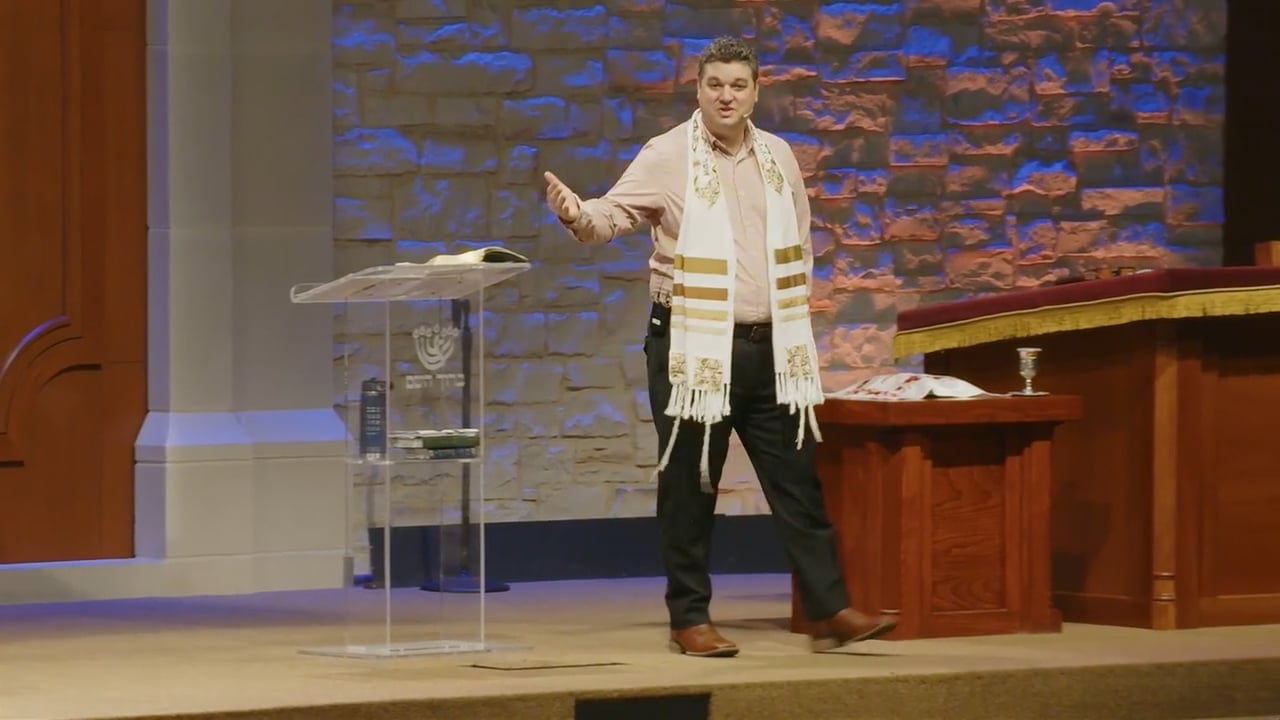
3:11 But this month out of the Jewish calendar this month is when the king comes out into the field. He's not dressed in his royal attire. He's dressed in what's appropriate to being in the field. That's one of the reasons I'm wearing a t-shirt. We'll get more into it as the message goes through, but this month marks that idea that you come to the king as you are. It doesn't mean that you stay as you are forever. I just wanna point that out because next week we enter Rosh Hashanah,
3:58 the king goes back into his castle, his throne room, and then now we have to come dressed differently. But the king expects you to come as you are during this season. In fact, the last time I wore a t-shirt on stage to speak was exactly five years ago this Shabbat. And I was finishing a series called Come As You Are, and I tied it into, and I finished, if I remember correctly, that was the finishing of the Book of Acts. Maybe I'm, maybe I'm off by a year. But, but it's a, it's a weird thing because today we're starting the Book of Acts
4:46 and the Book of Acts. Why are we starting the book of Acts? Well, number one, just practically, we just finished Luke. And so what comes after Luke acts? That's a trick question. Luke wrote Luke in Acts some believe as a single work, but at least according to the text as a volume one in volume two. So we're coming into this book, the Book of Acts during this season. So we're going to, this is what we're going to do today. We're going to step into the book of Acts for one day, and then for the rest of the holidays, we're gonna step back out into, uh, traditional readings and, and messages appropriate for the season.
5:35 And then after Sukkot, we'll come back and we'll step back into the Book of Acts again. So it's, it's like a false start, but not quite. Uh, and, and it's appropriate in my opinion. First of all, uh, one of the things that is amazing is just how this timed out. Now, if you've been here, or if you haven't, we started the Book of Luke, uh, about 20 months ago. And it took us about 19 months to finish the book of Luke. We didn't plan it that way, it just took that long. And as I was charting out when Acts was going to begin, I was like, man, this is pretty amazing. It's going to begin
6:22 right before the high Holy Days. The high holy Days. What, what is Rosh Hashanah mark on the Jewish calendar? Rosh Hashanah marks a new calendar, a new calendar year, you know, in the Gregorian years. We go, we, uh, on December 31st or January 1st, we wake up very full from having had Thanksgiving and Hanukkah and whatever other holiday you celebrate. We've been eating for like seven weeks. And it's during this time where we become very grateful for stretchy pants. And so we wake up on New Year's and we go, okay, I'm gonna start this new year and a new healthy way.
7:11 I'm going to exercise, I'm going to watch what I eat. I just want you to know I watch what I eat also. I watch it. No, I'm just playing. I watch the brisket as it enters into my mouth. Uh, it's only partially a joke, but we, we, in the, in the western world, we like to start with seasons of change. On the Jewish calendar, it's a little bit different. What we do is we look back over the last year and we see what we did wrong, and we then have this 10 day period where we
7:57 repent of what we've done in the past. I guess it's a se a season of change as well. And in fact, there's even a Shabbat right in the middle between Rosh Hashanah and Yom Kippur called Shabbat Shava, which means the Shabbat of repentance. And it's on the Shabbat by the way that we do our immersion ceremonies for new believers. And that one's on purpose. Why? Because it's a season where you repent and you turn to the back to the Lord, or you turn to the Lord, which means you change your direction that you're walking. So Rosh Hashanah marks a new year, and as we're entering into this new year, we're also entering into a new book, the Book of Acts. And what we're going to do is talk about
8:47 how the book of Acts, um, number one, how it was understood in that context, but number two, how does it apply to us both individually and collectively as em? Because I was texting with a buddy of mine this morning and he said, what's your, he was waiting to get on. He was here in town for the conference, and he was waiting at the airport to get onto an airplane. And uh, I asked him, I said, are you coming to service? And he said, no. And I said, well, I'm dressing just like you today. I'm wearing a T-shirt and a and a sport coat. And he goes, good. It's about time you finally changed up your outfit. And,
9:33 and anyways, he asked me what my message title was, And I said, my message title is, where are we going? And I said, and I'm starting the Book of Acts. And he says, the book of Acts is our script. It's our playbook. In other words, this is the way we are to live life. Why? How can I say that? Because Yeshua just spent, Luke spent the whole book of Luke describing the life of Yeshua and what he did every day and how he lived. And Yeshua says, now you go and do the same thing. Now we're gonna get, there's, there's more to it than that, but we'll, we're going to get into that. So let's, let's come here to the book of Acts,
10:22 chapter one. I wrote the first volume Theophilus about all that Yeshua began to do and teach up to the day. He was taken up after he had given orders by the kodesh to the emissaries he had chosen to them. He showed himself to be alive after his suffering through many convincing proofs, appearing to them for 40 days and speaking about the kingdom of God. Now, while staying with them, he commanded them not to leave Jerusalem, but to wait for what the father had promised, which he said, you heard from me for John immersed with water, but you will be immersed in the kodesh not many days from now.
11:11 So when they gathered together, they asked him, Lord, are you restoring the kingdom to Israel at this time? And he said to them, it is not your place to know the times or the seasons, which the Father has placed under his own control, but you'll receive power when the kodesh has come upon you, and you will be my witnesses in Jerusalem through all Judah or Judea and Samaria, and to the end of the earth. This is where we start the Book of Acts. But as I say, with every text that we get into,
11:56 when you read it, if it refers to something prior, it's important to remember what is prior. So he says, I wrote the first volume, Theophilus, I already mentioned this. We, we, the first volume is the book of Luke. And here in the book of Acts is not the place where the story begins. The story begins in the book of Luke. And we covered all through Luke about the life of Yeshua. We talked about Theophilus, who was Theophilus or who could he have been? Now Theophilus is the recipient of two volumes, not one, but two. We'll talk about Theophilus again in a few weeks.
12:48 In the first volume in Luke chapter 24, Luke wrote about all the Yeshua began to do and teach, oh no, I'm sorry. That's what he says here. This is, he says, Theophilus, I wrote the first volume Theophilus about all the Yeshua began to do and teach. In other words, this is everything. Yeshua set the standard. He did it and he taught it to his disciples at the same time, creating the understanding. I dunno about you guys, but there are multiple ways to disciple or to learn. If that word doesn't make sense to you, there's multiple ways to teach somebody how to do something. The way that worked best for me. Um, it it often starts with you. You just teach. You tell them what to do.
13:38 You, they don't do anything, but you just are told what to do. And, and you watch. Now, I will tell you, 95% of the time I didn't listen and I didn't watch. Then when it was my turn, I knew how to do it. This was especially true in my teenage years and still remains relatively true today. I learned best with my hands in the mess. And the problem is when you don't listen to someone else, your hands are always in a mess because you don't learn from other people's problems and mistakes. So my dad would teach me something and I would start to do it and he'd go, no,
14:25 no, no, no. Let me show you. Let me, let me help you. I'm gonna put my hand on your hand and, and, and we're gonna, we're gonna work on this project together. So we would do the project and he would watch and you'd say, okay, that was good. Now you can do it on your own. So you see what Yeshua has done through the book of Luke is Yeshua said, here, let me show you what to do. In fact, there were even times where he said, you guys go out and put and, and practice this. You guys go out, go to the, go to these cities and try it. Come back and we'll, we'll have a discussion there afterward. Now they've learned. And he says, okay, now I'm gonna release you to go do it on your own. And when you do it on your own, you are to model it for the next group and for the next group and for the next
15:13 group. And this is how we learn. Luke wrote about all the issue began to do and teach up to the day that he was taken up. In fact, Luke finishes the book of Luke in Luke 24 51 with he was carried up into heaven. And now we come back here and Yeshua's back on ground, but then goes back up to heaven. So it's, it's almost as if there's kind of about a three to five verse overlap between Luke and Acts. Now what Yeshua says, he says, uh, what Luke says here is he says, um, I wrote the first volume theopolis about all the Yeshua began to do and teach up to the day he was taken up after he had given orders by the kodesh
16:03 to the emissaries he had chosen. What were those orders? You see, when we read a text, we shouldn't stop and just as and just assume we know everything. We should ask the question, what are those orders? Well, the final order, which is reiterated in Acts, the final order is that they're to stay in the city of Jerusalem until they're fully equipped with power from on high with the Ruakaka kodesh before that in Luke 24, verses 45 through 48, Yeshua, is what it says is, Yeshua opened their minds to understand the scriptures. And he said to them, so it is written that the Messiah is to suffer and to rise from the dead on the third day.
16:49 And that repentance for the removal of sins is to be proclaimed in his name to all the nations beginning from Jerusalem. You are to witness all of these things. It sounds like an order, doesn't it? You are to witness about all of these things. So the last two orders Yeshua says, is, you are to be a witness And you have to wait here until I give you power, or until power comes from on high. What are they to be a witness of? They're to be a witness that the Messiah was to suffer and rise from the dead on the third day. And that because of that repentance, for the removal of sins is to be proclaimed in his name, in the name of Yeshua to all nations.
17:38 That's what there to be witnesses of. You'll be witnesses of all these things, and you are to wait here in Jerusalem until power comes from un high. Verse three to them, he showed himself to be alive after his suffering through many convincing proofs, appearing to them for 40 days and speaking about the kingdom of God. Yeshua cell showed himself to be alive after his suffering, his crucifixion, his death, and subsequent resurrection. What were the proofs again, as we read, we have to go back and remember because it's important. There was an empty tomb that Luke brings up. Two angels appeared to the women and told them that Yeshua has risen from the
18:23 dead. As he foretold them them, Peter then runs and sees the empty tomb and starts to scratch his head going, Hmm, I wonder why there's an empty tomb. There's a story. Then immediately the followers of two followers of Yeshua who are on the road and walking to Emmaus and Yeshua comes and walks with them and he says, what's going on you guys? What are you talking about? And they said, haven't you heard? All of Jerusalem knows? By the way, if you remember, how big was Jerusalem at this point? It's regular population was somewhere around the 20 to 40,000 people. But what it, what season is it? It's Passover.
19:11 Passover. The population would swell somewhere in the neighborhood of a hundred thousand to a million people would come into the city. Now, when we talked about this, uh, uh, about the Luke passage about Passover, I said, that would be like all of Dallas going up to Sanger and expecting to find some room. You guys can laugh. It's okay if you're from Texas. You understand? Like it's not possible. So you understand why it's so crowded. They're sitting there on the road, they're not sitting, they're walking on the road and Yeshuas goes, what's going on? And they go, haven't you heard all of Jerusalem knows? All a million people that are here today have heard what's going on?
19:59 And he says, well, what's going on? And he said, well, the man that we thought was our Messiah, he died. He was buried, and now we can't find his body. We misplaced it again. Think about this. It it sounds almost ludicrous. How could you misplace the body? Where'd the body go? We don't know. Some of the ladies, they, I think they didn't get enough sleep that night 'cause they were spouting some weird stuff. They got up too early, they had too many, they they had different spices with them than they thought they were bringing. They didn't know what they were talking about. And so they're walking along the road and he's, and,
20:45 and Yeshua starts to open up the scriptures to them and explain why and everything that had happened and concerning the Messiah. And they get to Emmaus and he says, I'm going on. And they say, no, no, come, come eat with us. And your your version may say that they broke bread together, but they didn't break bread because it's Passover. They broke Matza and Yeshuas. He lifted it up and he says, and it breaks it. And their eyes see him. And the moment they see him, he disappeared. It's a fascinating thing because when I talked about that passage,
21:31 my dad texted me and goes, you forgot the best part of it. And I was like, what's that? And he goes, the moment that they had faith to see him, they could no longer walk by sight. They had to walk by faith now. And because he disappeared from in front of them, he comes back, the, the, those two followers, they've made it to Emmaus. They run back to Jerusalem, they go, we saw him. The ladies weren't hallucinating or making stories up.
22:16 We saw him. And at that moment, Yeshua walks through the wall and into their mist and everybody freaks out. They're like, Woohoo, Lemme back up. I don't know if I wanna be near you. What are you? And he says, y'all come here. It so reminds me of Joseph with his brothers. He says, come here, Touch me. Feel my hands.
23:01 Feel the holes that are here. It's me. I'm not a ghost. So they began to poke and prod him, and they figure it out. And in that process, he goes, y'all, I'm hungry. Can I get some food? And as I mentioned before, if he was in Texas, he would've gotten some brisket, but instead he got some broiled fish. I don't know, it doesn't, just doesn't sound appetizing to me. But anyways, he, he's eating the broiled fish. And these are just some of the proofs that are listed in Luke. There's other proofs that are listed in the other gospels.
23:48 Yeshua continued to appear to his followers for 40 days speaking to them, all of the things concerning the kingdom of God. This 40 day period is a divinely appointed period of time. There are numerous mentions throughout the scriptures of periods of times that specify the number 40, the tribal leaders in the book of numbers went into the land of Israel to scout out the land for how many days? 40 Moses lived in the wilderness for 40 years before he was sent back to Egypt to bring,
24:35 to proclaim freedom for the captives and to bring release from bondage the Israelites dwelt in the wilderness for 40 years because of the 40 days when they came back and gave a bad report. Elijah spent 40 days and 40 ninths on Mount Horeb. In in, in one Kings 19, which is also known as Mount Sinai. Moses spends 40 days and nights multiple times on Mount Sinai. Yeshua at the book, at the beginning of the book of Luke, in Luke chapter four, spends 40 days in the wilderness as a season of preparation before his ministry. So here we are. Yeshua spends 40 days with his followers
25:23 as a season of preparation for them to begin to be ready to go out starting now. Uh, continuing in verse four. Now while staying with them, he commanded them not to leave Jerusalem, but to wait for what the father promised, which he said, you heard from me for John immersed with water, but you'll be immersed in the kodesh not many days from now. So when they gathered together, they asked him, Lord, are you restoring the kingdom to Israel at this time? And he said to them, it is not your place to know the times or the seasons which the Father has placed under his own control. Yeshua now commands them to remain in Jerusalem. Why? He says, why? Because the Father has promised the ak or the spirit or
26:11 power to come from on high. John immersed with water, but they will be immersed with the Holy Spirit when he says not many days from now. You know when, when is now? Well, it's 40 days after his, after Yeshua's resurrection. On what day was Yeshua resurrected on the festival, what is known as reit, the Festival of First Fruits. Now, when I, I explained some, some differences to the congregation, I think it was a month or two ago,
26:57 and it's super complicated, and I'm not going to explain them again, but I'm just gonna leave you with, it's super complicated. If you want a clarifying question or two, feel free to come ask me later. But Yeshua spin Rashi, when is Rashi? Rashi is day one of counting the Ooma day, one of counting the Ooma. You can find it in Leviticus 23, 11 and 15. And it says, in fact, I'm just gonna flip over there.
27:42 It says, he is to waive the omer before the Lord to be accepted to you before, uh, to be accepted for you on the Morrow, after the Shabbat. The kohan is to waive it again. In verse 15, you are to count from the mor after the Shabbat, from the day that you brought the OER of the wave offering seven complete Shava tote, or seven weeks until you get to Shavuot. So the phrase after the Shabbat has been interpreted in a couple different ways. First of all, Pesach it says is like a Shabbat. And so there's an interpretation that says the day after the Shabbat is the day after we celebrate Seder, which is would then be day two.
28:28 Or really we will start on night two, the end of day one. Super complicated. Everything in Judaism is complicated. However, there's another understanding that it's not necessarily referring to Pesach, the Shabbat, but in every week of Pesach there is what a Shabbat that then if it's the Shabbat that's during the week, it's from that Shabbat tomorrow after the Shabbat. So that would be Sunday that you count seven weeks. Therefore, sha would always be on a Sunday
29:13 Complicated. But if Yeshua is the first fruits of the resurrection of the dead, as he says that he, as we see written in scripture, that would be the first fruits of rei. Then Shavuot would be the coming together of his followers and being made acceptable before the Lord as a wave offering Jews and Gentiles one in a Messiah. And we have, there's so much more into that that I can't, I don't have time to. But anyways, so we are on day 40 counting after
29:58 Pesach. So we're on the 40th day of the Omere 40 days after his resurrection, which means Shavuot is how many days away? This is math. 50 minus 40, 10 days. 10 days ish. I always use an ish because it it, it makes it simple. And he says, stay here in Jerusalem until power comes from on high. Can I just give you guys some cheater notes here? They have to come back anyways because every Jewish man is required to be in Jerusalem on Passover, Shavuot,
30:47 and Sukkot. So at this point, it's almost not worth it. Even if they wanted to, to go home to make the two to three day trek home and then turn around two days later and make the two to three day trek back, it's almost not even worth it. Yeshua says, stay here. And they said, oh, thank you. We don't have to walk that far. Why on Shavuot would the spirit from on high be poured out? Well, here, this is interesting. Now I'm going outside of scripture. Um, but you can, you can make a case for it. But Jewish tradition says that the Torah was given to the Jewish people on Shavuot.
31:38 And if the Torah was given on Mount Sinai, on Shavuot, it seems appropriate that the power that would enable the people to follow the Torah would also be poured out on the same day. Now we're gonna get into some very fascinating, uh, coincidences. You guys all know I don't believe in coincidences, but there's some very fascinating coincidence coincidences. Uh, once we get into acts, which we'll get there probably in November-ish or December, it depends on how fast we go through acts. But now we come to first six and they're gathered there
32:26 together. What are the, they're gathered together. That's an interesting thing. I just want to ask a question for, for most cases, what do Jews gather together for, to eat? I say in most cases, because we're about to have one of the exceptions, uh, on the calendar coming up. But even on that exception, we gathered together to talk about not eating, building an anticipation for when we can eat. But Jews, we like to come together and eat. It's, uh, mostly reflected in our physiques, but um, they're coming together to eat a meal. And, and they ask 'em, they say, Lord,
33:12 are you restoring the kingdom to Israel at this time? They're addressing the issue, the current issue at that moment of Israel not being a sovereign nation of Israel, being underneath the yoke or the rule of Rome. You know, it seems to me this scripture has been taken out of context in so many different places, but it seems to me that if there was never to be a kingdom restoration to Israel, that Yeshua would've said at this point, no, that's never gonna happen. Didn't you understand? I came to not do that.
33:58 It seems like the right moment for him to say something like that. But he's, instead, he says in verse seven, it's not your place to know the times or the seasons, which the father has under his own control. This is when my children come to me, dad, when we leaving for dinner, it is not for me to tell you. It is the father's control. Oh, I guess that is my, for mine to tell. But anyways, they're like, dad, where are we going? What, what are we doing today? Are we doing anything special? Maybe you will see, I have learned, I learned very early on that I can never tell my children
34:49 whatever fun surprise that we're going to do over about 30 minutes in advance, because then if something happens and somebody gets sick, it is the end of the world. But I really wanted to go, dad, I don't know what to do, dad. You said the kingdom would be here now. Dad, please. I'm just gonna tell you, we are called the children of Israel for a reason. And all of us are called children of our father for a reason, because that's how we behave most of the time
35:38 when we don't get what we expect. Dad, when are we gonna be there? Soon? When is soon? Dad? Soon. Yeah. I know you said soon. Like when is it? When is soon? Dad? Soon. Sooner than the last time you asked me the question. But this is the way it is. When is the kingdom gonna be here, dad? Soon. It's not up to you to know when it's gonna be. Here is what Yeshua says.
36:23 He doesn't say, how dare you ask a stupid question that's so dumb because the kingdom's never coming here. He doesn't say, don't you realize what you are thinking about is the wrong way to think about it. I only came to hear that heal the spiritual rift between humanity and God caused by sin. The kingdom of Israel is no longer in the plan of God. That's not what Yeshua says. He says, it's not up to me to tell you the time or the season. That's the father's job. I'm here to start the process.
37:10 And what is that process? The process begins with a heart change. We see this in the book of Ezekiel in Ezekiel 36. He says, the Lord says, moreover, I will give you a new heart. I will put a new spirit within you. I will remove the stony heart from your flesh and give you a heart of flesh. I will put my spirit or my ruach within you. Isn't that very interesting? The kingdom has to come first on the inside and then it will be made evident on the outside.
37:57 I just wanna point out, this matches exactly what Yeshua has been addressing through the entire book of Luke. Your outside doesn't match what you proclaim to your inside to be. That's called hypocrisy. Why don't you go and change your inside so that it matches what you tell me you believe? You know, when Yeshua comes down hard on people, it's not because they proclaim themselves to be sinners. It's because they proclaim themself to be righteous and without blemish. And he sees what's on the inside and says, Hmm, I don't think so. You should go back and double check that.
38:42 Did you do your math right? One plus one does not equal three. What's on the inside doesn't match the outside. Therefore, the heart has to experience a change. In fact, by not refuting their question concerning the coming kingdom of God, Yeshua has in fact confirmed that one day there will be a physical restoration of the kingdom of Israel. Do you see what I'm saying? By not by, by not saying it's not coming, rather by saying you don't know the time or the season. What he's just done is confirmed that it will come,
39:33 but not before they receive power from on high, that will come and dwell within them. But you'll receive power when the kodesh has come upon you. Verse eight has come upon you, and you will be my witnesses in Jerusalem and through all Judah or Judea and Samaria into the end of the earth. When the power of the ruach comes upon them, it is confirmation of the prophecy that exists in Ezekiel 36. And once this exists, it says, this is where the Lord will gather his people from the nations, gather them from the nations, and bring them home and put a new heart in them, and he will fill them with his spirit and cause 'em to walk in his laws.
40:21 And then they will live in the land and he will be their God, and they will be his people. And he says, you will be my witnesses. He's already projecting that the beginning of the fulfillment is happening. Why? Because they will be filled with power, with the spirit of the Lord to go and be the witnesses. They are going to be the ones to share about the good news of what Yeshua has done. And now calling the people to repent and turn to the Lord in the name of Yeshua, the Messiah. By the way, this word witnesses is the Greek word from which we derive the word martyr.
41:06 Where are they going to be? Witnesses? Jerusalem, Judea, or Judah? Samaria to the end of the earth. We are going to delve deeper into that pattern, but that, uh, as we delve into acts, but that pattern becomes very evident throughout the Book of Acts as, as the progression of the sharing of the good news, uh, uh, continues to, to grow. It seems that the immediate understanding is that due to the exile after the destruction of Solomon's temple, that was the first temple. There were Jewish people in every direction to the end of the earth. If you look at maps from that, that time period, uh, I wish I would've, uh,
41:56 looked one up. I'll, I'll have one in October. But if you look at maps, you'll look and you'll see Jerusalem as the center. And you'll see, uh, it's like a leaf shape that goes off into the left and it says, or to the west, and it says Europe or Europa. And then you'll see another one that goes the other direction. It says, uh, Asia. And then you'll look, and there's one that goes down and it says, um, I can't remember if it says Africa, but it's what's known as Modern Day Africa. And that was the understanding that there were three primary continents, the the center of which was Jerusalem. And so when the gospel expands, when the good news goes out,
42:44 it goes out and it begins to go northward and, and eventually takes a westward turn, which we're gonna get into that. It's fascinating, but every time it goes out, it comes back to Jerusalem and it goes out again, and it comes back to Jerusalem. And we're left with Paul sitting in Rome in the book, at the very end of the Book of Acts, which represented nearly the end of the empire, but at least the central of the nations, if you will. And the gospel has gone out. And, and the Book of Acts ends. Now, the last time we talked through the Book of Acts, I said, the Book of Acts ends there because now it's our job.
43:29 We pick up where the Book of Acts ends. But it's really fascinating to think about this in this, in the, in the timeline of the history of the world. What we're on now is if, if with every growth outward, it returns to Jerusalem, we're on the return to Jerusalem section of that going outward, which means, uh, it's, it's interesting that Ben said it. The the goal was to have a Bible in every tribe in the next decade. I think it's pretty close to say that the ends of the earth have at least been touched,
44:14 which means you see all of these movements. Now, the Back to Jerusalem movement, the all of these different movements of this understanding. And, and I'm gonna tell you, it comes primarily from persecuted churches and indigenous churches that understand that it has to go back to where it started. It's unfortunate the Western Church doesn't quite get it all the time. Sometimes it doesn't and sometimes it doesn't. Uh, we fight that. But anyways, it seems at this point, and and we're gonna get into this as we get into acts more, it seems that at least the surface understanding of those who walk away from
45:00 Yeshua saying you're going to Jerusalem, Judea, Sumaria, the end of the earth, it seems that their understanding is that makes sense. The diaspora Jews are at the ends of the earth. We gotta go out and tell them so that then they can be brought back, which is what Ezekiel talks about. What's missed or misunderstood is the fact that it's the Lamb of God is too big for our household. You know, in, in, in, uh, in Exodus, it talks about sacrificing a lamb for Pesach, a lamb that's for the take one, appropriate for the size of your house. And it says, if the lamb is too big for your house, bring in the next household.
45:49 What is the reality? Is the Lamb of God. Yeshua, our Messiah is too big for the household of Israel. Therefore, what was missed at one point and then understood at another was that the Lamb of God, the mission of Yeshua isn't just for the Jewish people at the ends of the earth. It's for all of the nations to understand, to understand, to repent, and to come to the God of Abraham, Isaac, and Jacob. Now, I'm saying all of that because all of that influences the vision and the mission of B Hashem, the V. So if you want to come for a greater understanding,
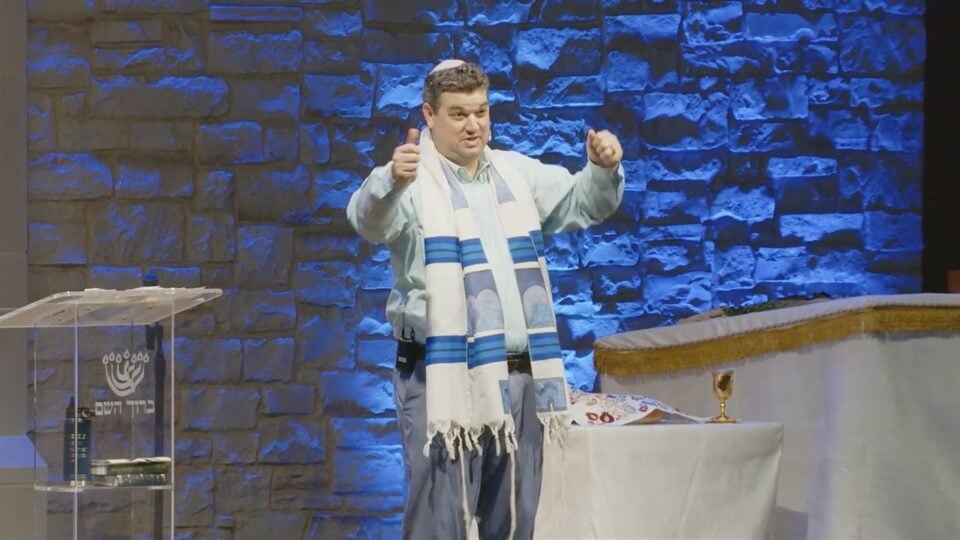
46:36 we're gonna dig even deeper tomorrow, because tomorrow I've got a couple hours today I don't, But okay, I, I can feel comfortable enough now to take off my jacket. This is our Barham T-shirt, right? Whew. I feel totally naked up here. Now I'm like, I don't even, I don't have a tallit, I don't have a jacket on. I got nothing. This is what, this is who we are, em, we exist to build community. Now you can see the color is a play on colors, and that's purposeful. Why? Because Ben talked about building. There's a,
47:25 there's a, there's a, um, a greater unity in the body of Messiah, perhaps than we've ever seen before. That's also what we do. So Bar Hashem, we build, we are in the process of building community. What does that mean? Well, it means that we are a group of people who are reckon, who are a reconciled community. What is, well, you're like, what does that mean? You just made me even more confused. We are Jews and Gentiles worshiping together in unity, in a messianic Jewish atmosphere or context. We are Jewish followers of Yeshua who can walk out our faith while maintaining our Jewish lifestyle. We are also
48:12 gentile believers, gentile Christians, who want to come and connect or reconnect with the, with the Jewish roots of their faith. And together we allow the light of Yeshua to shine through us Out into the Jewish community and into the rest of the world. Amen? Just as our continued existence is a witness to God's continued faithfulness toward the people of Israel and toward the nations. In other words, just by existing, just by being here every day, every Shabbat, just by being here, doing nothing else.
49:01 We are being a witness to God's faithfulness to the people of Israel and to the nations just by being here. So if just by being here isn't enough for you, I just want you to know that sometimes it is just enough, just, just by being here. Sometimes it's enough. The reality is the Jewish community in Dallas doesn't really know what to do with us because we have this massive building that is beautiful and they don't know what to do with us. I want you to know that's on purpose. You walk into here, there's nothing that's that, that,
49:50 that is to distract from the personhood of Yeshua himself. That's on purpose. Because it was my father's vision, and it's also mine that when a Jewish person comes here, they need to wrestle with Yeshua. They don't need to wrestle with my, my misguided projection of whatever it is that I want to put up. They don't need to wrestle with our, with my understanding of some of whatever they need to wrestle with Yeshua. Because the reality is, is when you wrestle with Yeshua, scripture shows us it is impossible to walk away
50:38 unchanged. Jacob. Woo. It's my belief that Jacob wrestled with Yeshua, and when he walked away, well before he walked away, Yeshua just knocked it, knocked it to him real good. Like just popped him in the hip. Jacob never walked without a limp for the rest of his life because he had a moment with Yeshua that changed his life forever. And that is the reason for our existence.
51:23 But sometimes some of us feel it's not enough to just be here and exist. What's up, dude? Come on. Sometimes it's not enough for just us to exist. So what you will notice over the, I'm I'm giving now I'm giving you forward-looking what is going to begin to happen. You will notice opportunities, uh, where you could begin to serve, Uh, both here inside Esham, but also outside our walls. Why? Because sometimes people just drive by us and they don't see us.
52:10 Sometimes we need to get out in the community and get our hands dirty and allow the light of Yeshua to shine in that moment. So you'll begin to see opportunities where you can do that, uh, here at Brook Hashem, where you can bear witness to the Lord's faithfulness in our lives. I just want you to know, first of all, everybody always asks me, well, where do you go to to, to, you know, share the good news with Jewish people? Do you wanna know where I go everywhere? I go regularly. Why? Because there's Jewish people everywhere. Like, they're in your library, they're in your grocery store.
52:56 I, I, one day and, and I, I wear t-shirts to provoke, generally speaking, which I guess I'm doing today. Um, but I was, one day I was at Costco, and this was back in the, in the season where we all wore masks. And, um, I was wearing a mask. And you know what's amazing? When you wear a mask, you forget about everything else that you're wearing. Like, it's like it blind. It's like blinders almost. So I'm at Costco and I'm wearing this t-shirt. It has Hebrew written on it. And this lady looks at me and goes, um, I can't even remember what my shirt said. Anyway, she read my shirt and I was, and I, it was a Hebrew word, and I looked at her and I was like, huh.
53:45 And I, I kind of was just like, I was like, uh, okay. And you know, I kind of walked off and, and I'm shopping a little bit more at Costco. And then I, I happened to look down and look at my shirt and I'm like, oh, she read my shirt. That's, she was, wasn't being weird. She was just reading my shirt. So I went back to her and I was like, I'm so sorry. I, I didn't know what to do with what you were, I was like, I forgot I was wearing this shirt. And it started up a 10 minute conversation where in the end, I invited her to Brook Hashem. So I'm telling you all of this stuff, because sometimes you just need a conversation starter, but you have to be ready to have the conversation. If you, if you're not ready to have the conversation, you just look like a dummy. You just look like, kinda like I did at Costco. Hey bud, you wanna go see mom?
54:31 Ah, come on, you're so heavy now. So anyways, all of that to say, if you are looking for opportunities or to create opportunities where you can share about the Lord's faithfulness both in your life and in the life of the household of Israel, we are going to begin to have those opportunities arise, uh, by partnering with other groups and organizations, both locally, nationally, I shouldn't say both locally, nationally, and, um, internationally. So I'm telling you that 'cause one of those international opportunities will at least begin to present itself on Yom Kippur, uh, because we're having a,
55:19 a guest speaker for our afternoon, um, time of teaching. Uh, so anyways, if you all of a sudden are looking at me like, I want that t-shirt, first of all, it kind of stinks now, so I can't give you mine. But, um, but these will be available, uh, on October 1st at the concert. So are you getting down? Are you getting down? Okay, so all of that to say, we are now entering into the book of Acts. In the book of Acts is where we walk out our faith and we will, we're gonna talk through all of these different instances in the book, and there's a lot, and we're gonna spend, I can't imagine anything less than a year and a half going through the book of
56:06 Acts. Maybe more, maybe less. But we will have a message every Shabbat, um, unless there's a guest speaker on the book of Acts. And then the wins the following Wednesday will be a deeper discussion on what we talked about during the message. So if you come and you're like, man, that was interesting, I'm looking more forward to like, who's Theophilus? Well then you come on Wednesday night and then you can ask those questions. Um, but not this Wednesday because we don't have Wednesday night programming this week. So that's why we're gonna restart one, one through eight again, and I'll give it again. I probably won't wear a t-shirt again. But that's, that's where we're going,
56:54 acts as who we are. And let's let the glory of the Lord shine through each and every one of us. May the Lord bless you and keep you. May the Lord make his face shine upon you and be gracious to you. May the Lord lift up his countenance upon you and give you peace.
58:03 In the name of our Messiah, Yeshua Shabbat Shalom.