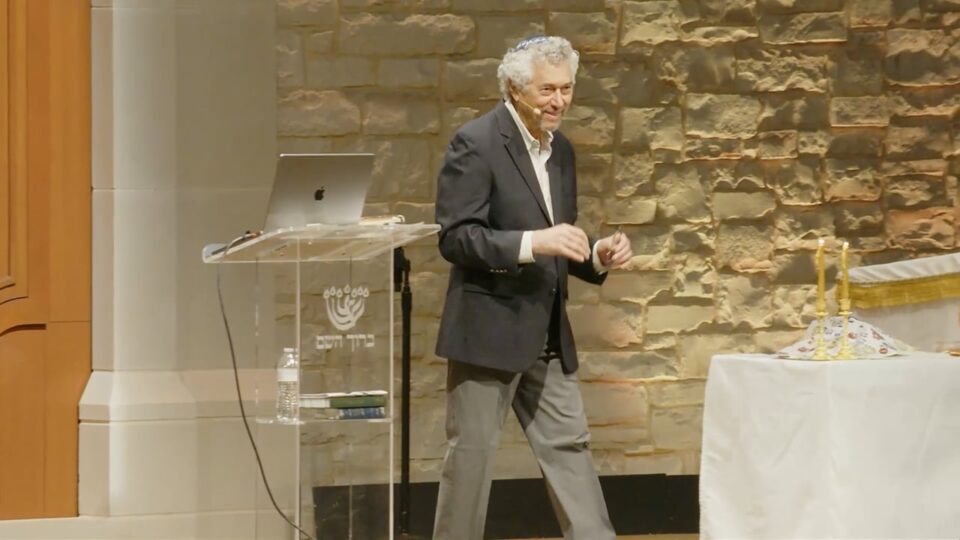

Message
Rabbi Marty Waldman•Gen. 21-22•October 3, 2024
Timestamps seek whichever format is playing — video or audio.
0:01 I would like to invite my dad, rabbi Marty, to come and share with us, share with us this morning, while it is yet morning, a sha sha may, our Father in heaven. Lord, I thank you, uh, for this day. I thank you for this Rosh Hashanah. I thank you for Rabbi Marty and, and, uh, the father that he has been to me. Lord, I thank you for the word that you have prepared within him and just ask that you would open up our ears that we might hear from you today in Yeshua's name. Amen. Amen. You know, rabbi Ari
0:47 and I, when he was a little bit younger, yeah, just for a minute. We used to, we used to, um, on Rosh Hashanah, on Rosh Hashanah Day service. We used to actually demonstrate what Abraham and Isaac did. And, um, you know, in, in Jewish thought, Isaac was actually maybe 37 years old, maybe a little, but in his thirties, not a, not a 12-year-old kid, like most people portray. And so when Ari was smaller, I could handle it, you know, just get him, get him, get him down on the, on the altar.
1:34 And, um, and then I put the knife against his throat, and his mother would say, Marty, Marty, yeah. But anyway, now, now he's gotten a little too big for me. But, uh, um, you know, seven years ago when we had the transition and, uh, and Ari took the mantle of leadership for the congregation, people wondered if he could fit in my shoes. And I, and my response is, no, he's two sizes bigger than I am. Thanks Ari. But thanks.
2:20 Thank you, Rory, for the introduction. But it's a joy and a pleasure to come and share thoughts about Rosh Hashanah with you. I like to give my messages, titles. So this year, as I was seeking the Lord about this, this message for the congregation, and it's my normal custom to ask the Lord what,
3:08 what you need, not what I need, what you need to hear. So sometimes he gives it to me. Sometimes I miss it. I hope today that he gave it to me. And so I wanna speak about this idea of a covenant of love and sacrifice. But before I do, I wanna share a Rosh Hashanah story with you, because Rosh Hashanah is known as a se, as a, a season of miracles. Some of you may not have realized that, but, um, many rabbis, many people in the Jewish community believe that
3:56 What some Christians called there are open heavens during Rosh Hashanah. And that this is a season of miracles. And I wanna share one of those miracles with you. So, an older Jewish woman just turned 90. She was preparing herself to attend the Rosh Hashanah service. When she became ill and called her doctor, he examined her carefully and looked doubtful, can you cure me in this new year? Doctor, the older woman asked, hopefully, dear Granny, said, the Doctor Soothingly, you know
4:44 what happens when one gets older? All sorts of ailments begin to happen. After all, even though this is Rosh Hashanah, which is often a season of miracles, a doctor is not a miracle man. He cannot make an old woman young who's asking to make me younger. The doc doc, she protested Irritably, she says, what I want is to grow older. Okay? Wasn't quite a miracle.
5:31 Somebody said yesterday, they miss my jokes. And I have to say, I do too. A covenant of love and sacrifice. Rosh Hashanah is centered around these two chapters of the book of Genesis. I shouldn't say centered, but these are the two chapters that are read during Rosh Hashanah In the more traditional Jewish community. Chapter 21 of Genesis is read today, and there's another service tomorrow. And chapter 22 is read tomorrow.
6:20 But I am going to reference both chapters. Since this is our practice. We don't do two Rosh Hashanah services, morning services, we only do one. We only observe one day of Rosh Hashanah, whereas the traditional Jewish community observes today in the diaspora, not necessarily in Israel. We in the diaspora, we always add, add stuff on. So I wanna, if, if I could, if I could just, if indulge you, I'd like to read, I'd actually like to read what Terry just read in Hebrew. I know it was also printed in English,
7:06 but I'd like to read it to you again. Now, it came about after these things that God tested Abraham, I'm gonna stop there for a minute because I want you to know Abraham was already declared righteous. Right? In chapter Genesis, chapter 15, the word of God says in verse six, Abraham believed God, he trusted in God, and God counted it to him as righteousness. God already accounted righteousness to Abraham,
7:52 not what Abraham did, but because he believed, Because he trusted God. God said, Abraham, look Abe, I know you're old, but I want you to go outside. Take a look at the stars in the sky. I'm gonna give you an offspring. And you're offspring will be as many as the stars in heaven. And Abraham believed God, and God accounted it to him as righteousness. So I, this is one little tidbit I just want you to take away. God does test the righteous.
8:40 He won't tempt us to evil. But the word test here means to prove. It's like when you get gold ore and it's mixed with other elements, and you throw it into a really hot fire and it melts everything. And the gold rises to the top or drops to the bottom. And when you're done, you have pure gold. That's what this test is. God does test us. He does test the righteous. And said to Abraham, uh, and, and God tested Abraham and said to Abraham,
9:26 and Abraham said to him, he ne, here I am Lord. And he said, take now your son, your only son whom you love, Isaac, and go to the land of Moria and offer him there as a burnt offering on one of the mountains. This word offer Isaac. Yes, it's means offering, but it literally is lift to lift up, to lift up, lift up Isaac there as a burnt offering.
10:19 So God said, Abraham, take now your son. And Abraham may have responded, well, Lord, I have two sons. Which one are you talking about? And the Lord says, your only son. Well, Lord, what do you mean my only son? And the Lord says, the one whom you love. Well, Lord, I love both of my sons.
11:06 And he says, Isaac, now keep in mind, Ishmael didn't live in the camp anymore. He was sent away years ago. But sometimes the Lord has to be very precise and let us know exactly what he's meaning. It reminded me of a story when Marlene and I were younger before Ari was born, and I was going to school to try and get a theological education. And we were very poor, poor students. And uh, it was during the rainy season
11:53 and I said, man, I really, it was in the winter. And I said, I really need a raincoat. So Marlene says, I'll start praying for you for a raincoat. And lo and behold, somebody gave me a raincoat. And it was a beautiful thing, beautiful raincoat, very expensive. But it was two sizes too big. And so we discussed it and we said, we're gonna have to get more specific about our prayers. And the Lord was being very specific about here, no ambiguity about what he's asking Isaac, uh, asking Abraham, your only son, the son that you love,
12:41 Isaac, and go to the land of Moria. Offer him there as a burnt offering on one of the mountains. I will show you nothing new to Abraham. Years and years ago, God told him to leave his home country and go to a land he was gonna show him. And Abraham believed him and said, okay, I'll follow you. Let's see what happens. So Abraham rose early in the morning and saddled his donkey, took two of his young men with him, and he took Isaac, his son, and he, he split wood for the burnt offering and a rose and went to the place of which God had told him. And on the third day, Abraham raised up his eyes
13:29 and he saw the place from a distance. Okay? So he knows this much. We know this much already. That Mount Moria from where Abraham was, was living in Be Sheva, Was a three-day walk. He didn't see it until the third day. How fast was he going? I'm gonna guess 15 to 18 miles a day, something like that. And Abraham said to his young men, stay here with the donkey.
14:16 I and the boy or the lad will go up. We will worship and we will return to you. Was Abraham a liar? God said, go up and offer Abraham offer your son y rock on Mount Moria. But he tells his guys working for him. He says, we're gonna go up and worship and we're gonna come back. We'll return to you more on that in a minute.
15:03 Abraham took the wood, took the burnt offering, or took the, the, yeah, the burnt offering and laid it on Isaac, his son. And he took in his hand the fire and the knife. So the two of them walked on to together. I'm gonna give you a little hint of where I'm going with this message, because I believe Isaac is a foreshadowing of Yeshua, a foreshadowing of Yeshua. He's not Yeshua, but he's giving us a prophetic insight,
15:48 a prophetic look into God's heart and mind in the future. Just keep that in mind, planting a little seed. So the two of them, he and Isaac, they walked on together. At first, I'm sure they were silent. Isaac was carrying the wood on his back. And Isaac spoke up and said, Hey dad, my father and Abraham said, Heini,
16:38 here I am my son. Behold the fire and the wood. But where is the lamb for the burnt offering? And Abraham said, God will provide, wow, God will provide for himself the lamb, the burnt offering, my son. So the two of them walked on together, probably in silence later on. This mountain was named by Abraham on the Mount.
17:25 God will provide, I deny you, but I want you to keep in mind. Isaac's question, where's the lamb? Dad that we came up here to worship and to sacrifice. So where's the lamb God will provide? Boy, don't we get into those positions sometimes? And we go, wow, where's my rent money? Where's this? Where's that? God will provide,
18:15 God will provide for himself. This was not for Abraham, not for Isaac, but for himself, the lamb. Then they came to the place, which God had told them. Abraham built an altar there and arranged the wood and bound his son. That's why this passage is called the binding of Isaac. And laid him on the altar, on top of the wood. So this is, remember I told you, keep this in mind that this is a foreshadowing of Yeshua. So Isaac carried the wood on his back to the place
19:03 like Yeshua carried the wood. And by the way, the wood here, the Hebrew word ets, is exactly the same word we find in the New Testament that some people call cross. It's really the wood, the tree. He carried it like Yeshua carried the wood, the tree on his back until they got to the place Isaac was bound. And Abraham put him on the altar to be sacrificed. Yeshua was nailed to the tree as an offering, not by the people who nailed him, but God would provide for himself the lamb of God
19:50 who takes away the sin of the world. So Abraham tied him up, found his hands and his feet, put him on the altar on top of the wood. Abraham stretched out his hand and took the knife to slay his son. And the angel said, Abraham, Abraham, here I am Lord boy. Everybody wants to ask Abraham something
20:37 or say, Abraham, Abraham. And they have to repeat it twice 'cause he is older and he can't hear that. Well, Abraham, Abraham and Abraham is always responding. He's always ready to respond and say, here I am. It's not like me with caller id. No, don't answer that call or you or a knock on the door and look through the people. No, I don't want to. I don't want that. I don't want to talk to that person. Don't answer the door. Abraham was always ready and he always said he, here I am.
21:24 He says, Abraham, Abraham. Now I know that you fear God because you have not withheld your son, your only son from me. May I re, may I expand on that a little bit? Your son, your only son whom you love. Isaac from me. When we give to God, when we offer something to God, he wants to know, are we offering the thing we love the most? The best thing. That's what he did with Canaan. When Canaan Abel brought offerings to the Lord,
22:10 Cain brought an offering out of his garden. Abel took his best, most beloved sheep and offered it to the Lord. And the scripture says in Genesis four, and God accepted Abel's offering, but did not accept Cain because Cain was just dropping his whatever it was before the Lord. Okay, this is what you wanted. Now, here it is. And Cain Abel was bringing the best thing what he loved the most. Abraham brought Isaac The son, the only son whom he loved, to the Lord.
22:55 And the Lord says, now I know. Now I know, Lord, I thought you knew in chapter 15, what are you? Hocking me a chin. You, you know, you're, what are you testing me for? The righteous are tested even in old age. I know it's terrible, isn't it? It's terrible. You think, okay, I passed the test. I'm 40 years old, it's all sailing clear sailing from here. Sorry, that's not necessarily the case.
23:43 So God provided, God provided a lamb in the, caught in the thicket, a ram caught in a thicket. Have you ever been in a thicket? I have. I was in a thicket Marley and I were living up in Washington state up in the northwest. I'm not gonna give you all the details, you don't need all that. But I was caught in the thicket and I was in the middle of the woods and I couldn't get past the thickets. In fact, within the thickets that were sticky and had stickers on them. And within the thickets there was a nest of mosquitoes and they were all over me.
24:28 So I left the thickets and I ran the other way, jumped in the, it was by a river. I jumped in the river. But, but the thicket easily catch you. I mean, you get stuck in the thicket and you're stuck. It hurts to move this way. It hurts to move that way. You're just stuck. The ram was caught in the thicket and God provided himself for himself the lamb. All right? So, oh, thanks for being innovative back there. Innovative. You actually put that on.
25:15 I'm gonna go back to my slides. Thank you. Now that I've given you this, read the whole story to you. I think the slides will make a little more sense. So here's a question. How about this, the trivia question, when does the, when does the word love? What? What's the first time the word love appears in? When does it appear in the Bible? What's the first instance of the word love in the Bible? Anybody know? Uh, able, maybe able or, you know, can Abel, I mean, no, I, I'll,
26:01 I'll answer the question for you. The first instance, the first appearance of the word love is right here in the passage that I just read to you. Genesis chapter 22. It doesn't mean that there weren't acts of love up until then, But the word love had not been used anywhere up until Genesis 22, the first time it's used. I'm saying that, and I'm emphasizing it because I believe it has also to do with Yeshua. For God so loved the world that he gave his only son, his only begotten son
26:50 God. A what God asked of Abraham, he himself gave, in Genesis 22, 2, he said, take your son, your only son whom you love c**k, and go to the land of Mariah and offer 'em up there. Just wanted to show you on the map. This is where they were living. Uh, let's see, can you see that little pointer right there? Bear Sheva. And here's where they were going.
27:36 They were going up to Mariah. That's a, that's 40 or 50 mile walk. So if you average 15 to 18 miles a day, you get there on the third day, you can see it still from a distance. You can see it on the third day. Is there a reference to, or can we see a prophetic reference in this whole story about Yeshua's death and then rising from the dead on the third day? So it was about a 40 or 50 mile walk. I'm sure they stopped at the rest.
28:22 Stop halfway up in the he run. It's also called ate Arba. And if, if you need to jog your memory a little bit later on under Joshua, this is where the giants lived, ate Arba at the rest stop. This is where the Giants lived. And Caleb said, give me that country. I'm gonna take it and I'll take the Giants, you know, and Caleb was 80 years old when he said that.
29:09 So they made it all the way up to Mariah. So you see there are two names, Mariah and Jbu or Yabos. So Mariah was purchased by King David. And there's a reference one Chronicles 21, 20 verse 22. King David saw the threshing floor of oh nine and he wanted it to offer as an offering place for the Lord. So he bought that threshing floor on the top of Mount Mariah, king David bought it.
29:58 And Later the temple was built there in that same spot of Solomon's temple. So David conquered Jbu, which was another part of that hill. It's all together, considered Jerusalem. But the temple mount was on Mount Mariah. And jab was probably David's where David lived after he became king, the city of David. And Solomon's temple was built there, as I mentioned, now stands there as the dome of the rock.
30:48 So this is a little bit of what the terrain looked like going up to the temple. Before there were roads and buses and cars, et cetera. And you were walking. Can you see why it only, only person could only walk about 15 miles a day? Yeah, pretty rough terrain, isn't it? On the top, you see Abraham looked up and on top there's Mount Mariah right there. You can see the temple. You can see the mosque up there. This is a later picture, of course. But this was Solomon's temple, a diagram built on that mountain Mount Mariah.
31:37 And I don't know, it's kind of bright. You can see where you can see where the rock is. Let's see if I can get up a little closer. Oops, that's not what I wanted to do. Ah, okay. Josh, if you're back there, you could you point the arrow. Yeah. See there's that rock where Abraham offered Isaac, or at least offered the sheep the ram. And on that spot was the arc of the covenant. As much as we know, as far as we know. And so Solomon built a temple there later.
32:26 So that rock now is covered by this dome, the dome of the rock. And there's the rock. It looks like it's been cut. So it may not be the full area. Looks like it's been cut by, by somebody. Goodbye dome. So as I was mentioning, the first time love appears is Genesis 22. And Yeshua said this in John 15, no one has greater love than a person
33:12 who lays down his life. In fact, I'll finish the verse for you, a couple of verses. This is my command. Yeshua says that you keep on loving each other just as I have loved you. No one has greater love than a person who lays down his life or his friends. You are my friends. If you do, would I command you? Don't, don't make this too complicated. This is Yeshua saying, I want you to love one another as I have loved you. So don't make this too complicated
33:58 because do as I command you means love one another. It's not overly, it's not complex. Don't think, oh, I have to fulfill all the Torah. I have to, I have to fill all the 10 commandments. I have to, I have to, you know, not only observe the 613 laws of the TaNaK, but another thousand in the New Testament. Oh, you didn't know there were commandments in the New Testament. Absolutely. So no greater love has a person than the one who lays down his life. And that's Yeshua. And if the rabbis or the Jewish scholars are correct,
34:46 and Isaac was actually in his thirties, maybe 37, the reason that that, that some people draw that conclusion is because, you know, there are no chapter breaks in the original. And right after chapter 22, chapter 23 begins, it's a new Torah portion called Zarah. It's a new Torah portion where they say that Sarah died. Isn't it interesting how the portion is called Sarah's life? And the first verse says, and she died. But they were that, that that portion is honoring Sarah's life. And that's what we do when we bury our dead.
35:31 We honor their life. And so in that portion it says that she lived to be 127 years old, 127. She was 90 when she gave birth, right? She was 90 when she gave birth to Isaac. And this chapter begins right after they returned to be Sheva from Mount Mariah. So you one could conclude that she, that that Isaac was 37 years old. If he was 37 years old and Abraham was 137
36:17 'cause he was a hundred when he was born, when Isaac was born. If Abraham was 137, how are you going to look at Ari Ari's six two? I still claim to be six feet, but I doubt it. How am I gonna take a, you know, a hunk like Ari and put him on a altar? No, Isaac had to be willing. Isaac had to be willing, he had to be obedient to his father. And about Yeshua, just like the book of Hebrews says that Yeshua learned obedience through suffering.
37:06 Isn't that terrible? That's a terrible verse. I mean, if Yeshua had to learn obedience through suffering, what does that mean for us? Yeshua laid is down his life, down willingly. I believe Isaac did as well. So here's the backstory really quickly to this, to Genesis 22. Abraham believed God and was considered righteous by God in Genesis 15. And God in, in Genesis 15, because of that faith,
37:53 God made a covenant with him. It's called the Abraham land covenant. That means God gave him a piece of land in the Middle East, not just to him. He gave it to Isaac, he gave it to Jacob, to all the 12 tribes of Israel and for all of their descendants forever. If you believe the Bible, there's no disputing what God gave. It's not based on our righteousness. God's promise. It's based on God's favor toward Abraham. Because Abraham believed God. And if we want an inheritance in heaven, all we need do
38:42 is believe God. I know that sounds too simple. I know it sounds too simple, but if we really believe God, if we really put our trust in him, you know what's gonna happen? We're actually gonna act like it. If we really, if we're not acting like it, we really don't believe it. If we really believe it and really trust in the Lord, we're gonna act like it. We're gonna be obedient. Like Abraham was, chapter 16, Ishmael was born and God promised that he would multiply Ishmael because he was Abraham's seed.
39:32 And I have to stop and just say for a second a lot of, well-meaning, and I think a lot of, well-meaning Christians say that all the Arabs in the Middle East are descended from Ishmael. It's not true. You know, Abraham had another wife, Catura, who had lots of sons who also populated what we know as the Arab world, but he did promise multiplication to Ishmael. In Genesis 17, God reiterates the covenant to Abraham.
40:19 But he says it's gonna be through your son who is gonna be born of Sarah, not through Ishmael. It's a tough word I know, but it's, that's what the Bible says In Genesis 18. The Lord appears to Abraham and makes a promise to Abraham and says, next year at this time, you're gonna have a son and you're gonna name him laughter. You know why? 'cause you're so old, everybody's gonna laugh with you and rejoice with you. Wow. And he's
41:05 going to be the son of the covenant. So he's gonna be the son of the covenant of love and sacrifice. Genesis 21, Isaac is born and he's weaned. Yeah, done nursing. Ishmael makes fun of him. Him and Sarah believes that he needs to be sent away. She goes to Abraham and says, you need to send Ishmael and Hagar away.
41:52 And Abraham was the word. The literal word says distressed. That word means evil in the eyes wasn't depressed, he was distressed evil in the eyes. So he sought the Lord in the Lord, said, Hey Abe, listen to your wife. I know that's tough for some of the men, tough for some of us. You know, listen to your wife. Now look, our wives are not always right after all, it was Sarah who gave him Hagar to have a baby, right?
42:39 Then she probably turned around and said, look, Abraham, this is your problem. But, but we know, we know in the New Testament that Ishmael is called the son of the flesh. And Isaac has called the son of the Spirit. It's, it's a mid rush in Galatians. So he sent Ishmael away again here in Israel, down from be Sheva to the wilderness of Piran, which is, well, I'll show you where it is. Here's Ishmael going down to Piran with Hagar.
43:27 By the way, Hagar was an Egyptian. Just keep that in mind. Hagar was an Egyptian. So she went down toward Egypt and that's where she was. So it was in between Israel, Jordan, Saudi Arabia, and Egypt. That's where he dwelt, that's where he dwelt, got married, had kids, also had 12 tribes of Ishmael. So Abraham is known as the father of faith, just as he was called to lift up Isaac as a burned offering.
44:17 And he did it. He responded by faith and now he's called the father of faith. Everybody who believes, by the way the New Testament says this in Galatians three, everyone who believes in Yeshua, particularly of the nations, everyone who believes in Yeshua is now son or daughter of Abraham. What? Why is that? Because Abraham is the one who is the father of faith. It doesn't mean you're literally a physical descendant. It means that you are a descendant by faith because you have trusted the Lord in Yeshua. In Hebrews 11, 17 through 19,
45:08 by trusting Abraham when he was put to the test, offered up Yk as a sacrifice. Yes, he offered up his only son who had received the promises, to whom it had been said, what is called your seed will be in Isaac for he had concluded that God could even raise people from the dead. And figuratively speaking, this is exactly what happened. He took Isaac up, didn't wanna offer him, but he was being obedient to the Lord. The Lord stopped him and gave a substitute sacrifice. But Abraham apparently had so much trust
45:55 and faith in what God said concerning Isaac and the future of Abraham Isaac. And then we we'll meet Jacob later that he said, God, the only thing, the only thing God can do is raise him from the dead. And that's the conclusion that the writer of the book of Hebrews draws that Abraham believed that God would raise him from the dead. And he said, and that's exactly what he did. Figuratively, he brought him off the altar. He was good as dead, brought him off the altar. God provided a substitute. I want you to catch this because it's very subtle, very poignant about Yeshua. Everyone who lives in sin is as good as dead.
46:47 But God offered a substitute in Yeshua and figuratively speaking, spiritually speaking, we have been raised from the dead in Yeshua, our Messiah. Abraham is known as the father of faith in the New Testament. We read it in Romans chapter four. Then what should we say? Abraham, our forefather obtained by his own efforts for if Abraham came to be considered righteous by God because of legalistic observances, then he has something to boast about. But, but this is not how it is before God.
47:32 For what does the tanah say? Abraham put his trust in the Lord and it was credited to his account as righteousness. My son, whom I love. In John chapter one, verse 14, the word of God became a human being. The father's only son full of grace and truth. Now, just remember in Exodus chapter six, Israel is called God's Son. God is redeeming and rescuing Israel out of Egypt because this is my son. He says in chapter six, but Yeshua he says, is my only begotten son.
48:19 So there's something different about Yeshua, and I believe there's something the same and different. The D, the the same is that I believe. And the difference is that I believe Yeshua Is the perfect, how should I put this? The perfect manifestation of perfect Israel, of an obedient, perfectly obedient Israel. So Yeshua represents Israel as that perfect, obedient, sacrificial Israel. What was in the loins of Isaac Jacob
49:04 and the 12 tribes of Israel that would've been sacrificed on the altar, had Isaac really been killed there. So Yeshua is perfect. Israel personified, he's the word of God. I know I'm taking longer than I should, but who? Who knows? Who knows where the word of God first appears. Genesis chapter one, verse three. In chapter one, verse one,
49:50 the Lord created the heavens and the earth. In verse two, the Holy Spirit, the spirit of God, the Rahim, Harvard above the earth, above the deep. And in chapter, in verse three, chapter one, verse three, he says, and the Lord spoke for the very first time the Lord spoke, the word of God came forth. And in John chapter one, it says, nothing was created apart from the word who became flesh. The word when God spoke, he spoke the universe into being Yeshua. When, when the Bible says Yeshua was there and, and even
50:37 before the world was created because Yeshua was the word of God in God and it didn't come out until he spoke it. He is full of grace and truth. Matthew three 17, A voice from heaven comes a bot. Coal. This is my son whom I love. Does that sound like Isaac, Abraham and Isaac? God says, this is my son. This about Yeshua. This is my son whom I love. Yeshua was both Isaac and the Ram caught in the thicket.
51:24 Can you picture that? Isaac was the promised seed. He's the promised one. The covenant would come through Isaac and be continued. The ram was the substitute sacrifice. Yeshua is the promised one who was was to come. The Ma Shia, the son of the living God. But he also became the substitute for us. I know this is kind of nuts, but I see Abraham as God the Father, Isaac as God the son and Jacob as the people of Israel and all those who put their trust in the Lord. I know that sounds kind of weird, doesn't it? That's okay.
52:12 You can think about it. I love art and I love this particular artist, mark Shial. He painted this painting in 1966. It's called The Sacrifice of Isaac. And I just want to point out here a few things. He actually, mark Shial is actually considered by many art historians to be the quintessential Jewish artist of the 20th century. So here's Abraham, obviously with the knife, Isaac on the altar.
53:00 Abraham holding him down, caressing him softly with his hand while he holds the knife up, the ram caught in the thicket that he hasn't seen yet. I think this is probably Sarah who is wondering what happened to her son, the angel of the Lord who came and said Abraham. Abraham. A vision of the future in Yeshua on the cross, on the tree that is prophetically envisioned in Isaac. Here are Christians who are bowing down to Yeshua. Here are Jews I'm hoping,
53:47 who are rejoicing in coming to Yeshua. That may not be the way Mark Shal saw it, but that's how I see it. Jews from the Ettl, and this may be a picture of Miriam with the baby Yeshua. I don't know. Anyway, it may not be how Mark Shal intended, but that's how I see it. Mark Shal, you'll find, you'll find this, these Jewish symbols along with the cross or some Christian symbols, often in Marc Al's paintings. Marc Chaga, by the way, was brought up, he may be secular at this point, but he was brought up just the way Moshe was brought up.
54:35 He was brought up in a strong in the Hasidic community and that's how, that's how he was brought up. So I just wanna quickly say, I've already kind of intimated this in John three, chapter three, verse 14. Just as Mosha lifted up the serpent in the desert, so must the son of man be lifted up. This is what Yeshua said, John 1232. When Yeshua is lifted up, he will draw all people to himself
55:20 in two Corinthians five 17. This is in honor of Rosh Hashanah being considered the New Year and anything is possible in the New Year. Therefore, if anyone is united with the Messiah, he is a new creation. Ari mentioned this last night, the old has passed past. Look what has come is fresh and new in our Messiah. It's Rosh Hashanah. Thanks for being patient. Shava Tvu.
56:09 So this is, this phrase is, may your name be written in the Book of Life for a good year. This is a shortened phrase. It, it's longer than that. But may I add, may your name be written in the Lamb's book of life for eternity, not just a new year. May the Lord bless you and keep you. May the Lord make his face shine upon you and be gracious to you. May the Lord lift up his countenance upon you and give you peace.
57:25 In the name of our Messiah, Yeshua. Amen. Happy New Year.