
Message
Rabbi Shawn Moir•Deut. 7:1-11•September 24, 2023
Timestamps seek whichever format is playing — video or audio.
0:00 I would like to invite Rabbi Sean to come this evening and share with us the word that the Lord has put on his heart. Ave May my Father in heaven. Lord, I thank you for Rabbi Sean or I thank you for his preparation and his diligence to prepare for tonight. Lord, I pray that you would speak to us through Rabbi Sean. Open our ears to hear from you. Oh Lord, we bless you. In Yeshua's name. Amen. Amen. Thank you Rabbi Ari. Thank you. Ensemble hovering. That was beautiful.
0:48 On June 1st, 2014, Val, my wife and I, Val is my wife, not Val, my wife and I. Uh, we finished our move from Southern California to Texas. I drove a 26 foot U-Haul truck with a trailer for our Honda Odyssey. We arrived on the third day of our trip. It was a wild journey. We traveled with a dog and a chicken in the cab with us. Five minutes into our trip, my iPhone was destroyed. I won't share that story tonight, so all we had to guide us on our journey was a G P S from the early two
1:36 thousands. Several times during our trip, we were led to roads which no longer existed. I can clearly remember having to back the truck and trailer out of a narrow alley in the middle of the night, as well as a few other near disasters on the way. I remember running low on fuel in the hills of Arizona and the desperate feeling of not knowing whether we would be stranded. I was relieved to find a gas station. It was even called the Oasis in the wilderness, Where I gladly paid over $7 per gallon to fill up the tank. When we finally arrived at our rental property,
2:23 we could see the owners and their children scurrying and cleaning the house through the front windows. The house was not even close to being ready for us to move in. We were exhausted and frustrated as we were told that the home would be ready for us. When we arrived, Gretchen and her boys showed up out of nowhere and unloaded our truck. 26 foot truck. Yeah, they even washed the baseboards of our home. That was our introduction to the Sams. Could we have a hand for the Sams?
3:09 There were. There were other community members who showed up as well. I didn't even know them at the time. They were just a bunch of new faces. Maybe some of you were there that day helping us in so many ways and reminding us of God's faithfulness. Since the carpets clearly needed to be shampooed, we could not set up our furniture in the bedrooms. Everything was brought into the living room and it took us an embarrassingly long time to move those items out of the living room and those boxes and into the appropriate rooms. It felt like the home and the yard needed both a physical and spiritual cleansing zinc.
3:56 The prior tenants had some big dogs. There was a distinct smell and marks all over the walls, and especially on the doors. The front porch was nice, but there were cigarette butts everywhere. I remember a big Buddha statue on the front porch. I believe his head was being used as an ashtray disposing of this statue, cleaning up the home and yard and putting up our meso. All had spiritual significance. After getting settled, the home served us well for two years. In spite of challenges, God has shown tremendous kindness to us.
4:43 We are now observing the High Holy Days here at Baruch Hashem for the 10th time. So much has transpired in the last decade. Though we have been tested in various ways, God's faithfulness has always been on display on this era of Yom Kippur. I want to encourage you that God keeps his covenant. I would like to open up a passage of scripture that is not typically associated with Yom Kippur. However, I believe that it has relevance to us at this season. While we read from Deuteronomy chapter six, the Shama in virtually every service,
5:30 it is not often that we continue to the following chapter. Many would prefer to skip this chapter as it is a difficult chapter. However, I believe that Yom Kippur is an aptt time to to be confronted by God and his word. In spite of this being a difficult chapter. If we press through the difficulty, If we press through the difficulty, a message of hope emerges. Ultimately, this seemingly dark passage points to God's covenant faithfulness. I have entitled this message. Choose Your Path,
6:19 and I would like to demonstrate three points from Deuteronomy chapter seven verses one through 11. First, we need to know before whom we stand. Second, we need to remember our salvation, and finally, we need to be faithful to the covenant which God has called us to. Although he has been faithful. Can we say the same of ourselves? My outline can be found on the you version app and I will be reading from the Tree of Life version. Deuteronomy seven verses one through six, read as follows. When otai, your God brings you into the land you are entering to possess and drives out
7:08 many nations before you, the Hittite and the Geir and the Amorite, the Canaanite and the parasite, the hitite and the Jebusite. Seven nations more numerous and mightier than you and Adonai, your God gives them over to you and you strike them down. Then you are to utterly destroy them. You are to make no covenant with them and show no mercy to them. You are not to intermarry with them. You are not to give your daughter to his son or take his daughter for your son, for he will turn your son away from following me to serve other gods. Then the anger of Otto Nai will be kindled against you and he will
7:57 swiftly destroy you. Instead, you are to deal with them like this. Tear down their pillar, uh, tear down their altars, smash their pillars, cut down their Asher poles and burn their carved images with fire. For you are a holy people to adonai your God from all the peoples on the face of the earth, Adonai your God has chosen you to be His treasured people Know before whom you stand. This phrase is found in tract Tate barot of the Babylonian
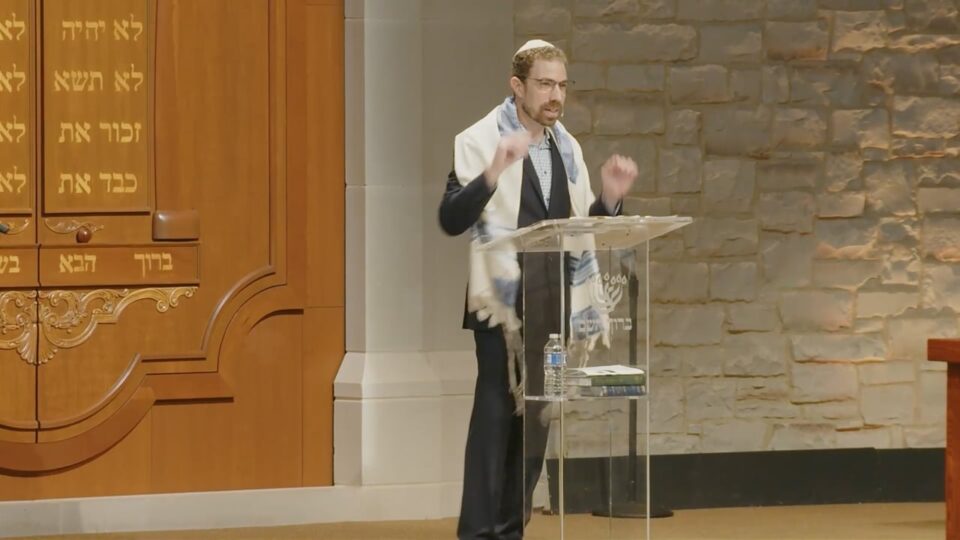
8:43 Talmud. You'll also see it on the wall in our prayer room and it appears above the Torah arc. In many synagogues, this phrase reminds us of the awesome power of the Lord. It has also been utilized in the sense of knowing when God has placed us at an opportune moment and we need to act accordingly. I believe that Yom Kippur is an APTT time to recall this saying as we find ourselves before the ark, the mercy seat recognizing our sin before him as well as his atoning work through our Messiah Yeshua, but what does this have to do with Deuteronomy seven
9:32 in verse six? God reminds the people of Israel that they are to be a holy people to otai their God. God has chosen Israel to be a sah, a treasured possession evoking the language of the Exodus. Yes, this is good and fine. However, what do we do with the first five verses of this chapter? How can God simply wipe out seven nations? Isn't he a caring and compassionate God? What did these people do wrong anyway? A seven nation army couldn't hold God back,
10:19 but what is God's history with these seven nations? First, it is important to recognize that these seven nations are each called out by name. Is that everyone? Why are different titles used at times in different books? The use of seven nations here seems to imply completeness, a large number. Clearly, they outnumber Israel and also appear to be stronger and larger in stature. Also, it is important to note that God did not just tell Israel to wipe out the inhabitants of the land.
11:06 He named specific groups that have a history with God and have a history with the people of Israel. An entire study on the various people groups listed here and in other passages could be a college course. Surely there are many writings of other cultures that we would need to access or that may have been destroyed over time. However, scripture itself gives us a good baseline understanding of God's history with the inhabitants of the land. I have said that I believe this passage is primarily
11:53 about God keeping his covenant. What do I mean when I say covenant? There is a binding agreement typically between two parties. Let's briefly look at some of the major covenants found in the Hebrew Bible. In Genesis nine, we have a passage known as the NOIC covenant. Although God had reached his limit with the evil of humanity, Noah found favor with God and God made a covenant with Noah and his descendants to not cut off all flesh by way of a flood. Immediately following this covenant,
12:38 we have a story with Noah and his sons ham, who is the father of Canaan, Shamess, his father Noah. In response, Noah declares cursed. Is Canaan the lowest slave will he be to his brothers? It goes on to say that Shem, a son who honors Noah will be blessed and Canaan will be cursed. Of course, there are many questions that arise with such a passage such as why Canaan is cursed instead of have. However, these are outside the scope of our study for tonight.
13:23 I simply want to point out the history with Canaan and his descendants. Canaanites are sometimes referred to as one of the groups in the land. At other times, the entirety of the inhabitants are referred to as Canaanites. Let's keep going. The next major covenant is found in Genesis 12 and 15. This is known as the Abrahamic covenant. There God makes a promise to Abraham concerning the land of Israel. Again, the Canaanites are mentioned as inhabitants of the land. In chapter 15, God literally cuts a covenant with Abraham,
14:10 not the one you're thinking about. Here they have an interesting conversation. God predicts the enslavement of the people of Israel for 400 years. He then declares that he will judge their oppressor who we of course know as Egypt. Then after four generations, the people of Israel will return to the land and here is a quote from that passage for the inequity of the Amorites is not yet complete. The term Canaanite and amorite can be used generally to regard to the inhabitants of the land. However, Genesis 15 goes on to be more explicit.
14:59 Listing 10 people groups. The hi bytes are the only one group in Deuteronomy seven that is not mentioned in this list in Genesis 15. However, Genesis Genesis 10 tells us that the hi bytes are also descendants of Canaan, so all of these groups mentioned in Deuteronomy seven have a history with God and the people of Israel. Now, we will fast forward, get it fast forward, pass the covenant of circumcision and up to the mosaic covenant. What does this have to do with Deuteronomy seven? In Exodus 19,
15:46 God reminds the people of their deliverance from Egypt and refers to them as His his treasured possession. A phrase we find again in Deuteronomy seven verse six. We will now breeze past the 10 commandments in Exodus 20, remembering God's ethics concerning idolatry to Exodus 24. Just after telling Israel that he would drive out the inhabitants of the land and give Israel their inheritance, God cuts a covenant with Moses and the people concerning their obedience to follow the Torah. In two Samuel seven, we have what is known as the Davidic covenant.
16:34 Here we read that God will establish David and the throne of his descendants forever. This is one of the passages from which we see Messianic expectation through the line of King David. I will mention just one more covenant before returning to Deuteronomy. In Jeremiah 31 30 and following, we see a description of a new covenant where the Torah is written upon the heart of God's people. So you may be thinking, why did we just take this excursion to look at five covenants throughout the Tanakh? I wanted to show you that God has had an ongoing relationship with the house of Israel as well as the seven nations that are listed in
17:24 Deuteronomy seven. Additionally here in Deuteronomy seven, the idea of covenant is prominent. When we use this term covenant, it should evoke these various concepts throughout the history of Israel. However, I understand that it is difficult to hold all of these varied ideas of covenant at the forefront of our minds at a given time, so I will attempt to make the issue a bit simpler. Let's shift back into the context of Deuteronomy seven. Looking at five different covenants is a bit much. What if we were to boil the issue down to two words?
18:11 Our first word is found in Deuteronomy seven verse two. The root that I'm referring to is em, as you see there on your left. What is haram? Haram is not such an easy term to define. It is part of what makes this passage difficult. My Hebrew lexicon defines it in the following ways, dedication to exclusion from profane use to destruction or to solely cultic use ban or what is banned in the context of this passage,
18:57 it seems to have the following possible range of meaning. At the very least, Israel was to disassociate from these people and to not be entangled with them At the most extreme level, Israel was to kill them all. As is true with most things, the wisest interpretation lays somewhere in the middle. Now, this is not merely metaphorical speech. God is not simply telling Israel to ignore the inhabitants of the land. Clearly, God was telling Israel that they needed to take an active role in driving them out, specifically striking them down,
19:45 making no covenants with them having no mercy, not intermarrying, tearing down their altars, smashing their pillars, cutting down their asra poles and burning their carved images or idols with fire. This does not sound metaphorical or passive, does it? This is hostile and militaristic language. However, for those of us who would be quick to jump to an extreme definition of what God meant by em, we must also consider the following. Just after God tells Israel to utterly destroy the
20:30 inhabitants of the land, he tells them not to make covenants with them. How would you make covenants with dead people? He tells them not to intermarry with them. Would they be tempted to marry corpses if Israel was to kill them all? Why would God need to prohibit intermarriage later in this chapter in verse 22, to make things even more confusing, God tells Israel that he himself will drive those nations away little by little, not all at once, lest the beasts of the field overpower them.
21:19 Now, furthermore, we know that Israel did not kill the inhabitants of the land. For instance, Rahab is a Canaanite woman who is commended by the writer of Hebrews and James or Yakov as a righteous woman because she welcomed the Israelite spies into Jericho. She, along with Tamar, who are both Canaanites are mentioned in the very lineage of King David. Also included there is Ruth the Moabite. These Canaanites are in the very lineage of King David and the Messiah, Yeshua or any other Messiah who had proposed to come from the line of David.
22:09 So what is God saying through all of this? Furthermore, Israel is warrant that if they did not carry out his instruction of harem concerning the Canaanites, they too would become harem in this command. There was also an implicit threat to the people of Israel if they failed, if carry out God's instruction. In fact, at the Babylonian exile, when the Israelites are vomited out from the land, one could even say that Israel too became em.
22:56 Israel was being told to know before whom they stood. God is all powerful. He could overtake the enemy by himself like he did when he delivered Israel from Egypt, And although it was God who would be driving out the nations and the inhabitants of the land, he called upon Israel to play an active role in driving out the enemy and inhabiting their inheritance. Their success in the land depended upon their faithfulness to his covenant. God had upheld his side of the agreement. The question was whether Israel would uphold their side in being
23:43 obedient to God's call. If they could not commit the Canaanites to harem, Israel would become harem. What do we learn from this? Among other things, God does not take inequity lightly. We too must know before whom we stand like the people of Israel at the time of Moses. We too have failed to carry out the instruction of the Lord, the Torah. While our deeds might seem good in our own eyes, our garments are stained when we stand before the Lord.
24:31 Deuteronomy chapter seven verses seven through eight, read as follows, it is not because you are more numerous. There it is than all the peoples that Otai set his love on you and chose you for you are the least of all peoples. Rather, because of his love for you and his keeping the oath he swore to your fathers, Adonai brought you out with a mighty hand and redeemed you from the house of slavery, from the hand of Pharaoh, king of Egypt, Remember your salvation. At every point in our journey, God is pointing back to Pesach.
25:19 It is there that we recall our brokenness and his power. It is from that point in history that we could take courage to press onward trusting the Lord in spite of our own weakness. Here God reminds Israel once again of the promise to Abraham. When the nation was at its inception, the small people that God made great, yet even at this point in history, they were outnumbered and outsized by the inhabitants of the land. However, God's calling had nothing to do with the size of the people. God reminds them of his promise to the patriarchs.
26:07 God keeps his covenant. As we perused the different uses of the term covenant in scripture earlier, we see that this word evokes past, present, and future life for the people of God. We are to recall his faithfulness to walk in covenant with him in our days and to look forward to a future where we will live in dynamic relationship with the God of Israel and the nations. Ultimately, God chooses Israel because he loves the nations. Israel is the vessel through which God reveals himself to humanity.
26:54 Yeshua, the living Torah came to walk out that which neither we nor our fathers could fulfill. Not only did he bear our righteousness before the Lord, but he also bore our shame becoming harem for our sake. Derem 21, 22, Deuteronomy 21, 22 says that anyone hung upon the tree is cursed, yet he became cursed. For our sake, the writer of Hebrews tells us that Yeshua offered to God without blemish,
27:41 cleanses our conscience to serve the living God. He is the mediator of the new covenant prophesied through Jeremiah just like the people of Israel living on the verge of entering their inheritance. God would remind us today, especially today, that it is not because of our size that he has called us. It is not due to any special ability. We are not worthy of his salvation. It is because of his promises to the patriarchs and because he is a covenant keeping God that we have access
28:26 to his salvation. It is the mercy of God that leads us to repentance and leads us to new life in him. Deuteronomy seven verses nine through 11 read as follows, know therefore that otai your God, he is God, the faithful God who keeps covenant kindness for a thousand generations with those who love him and keep his mitzvot, but repays those who hate him to their face to annihilate them. He will not hesitate with him who hates him. He will repay him to his face. Therefore,
29:13 you are to keep the commandment, both the statutes and the ordinances that I am commanding you today to do them, Keep the covenant. As I said earlier, the question is not whether God will uphold his covenant. The question concerns our willingness to honor his covenant. This section speaks of the faithfulness of our God. He is the faithful God who keeps covenant kindness for a thousand generations with those who love him and keep his mitzvot, his commandments. In this verse, we have another key term.
29:59 Earlier we spoke about em. As you see there on your left, it is not until we understand em that we can understand this key Hebrew term from verse nine, Hassed. It has to do with obligation, loyalty, kindness that pursues you and grace. I believe that these two terms are bound together closely in understanding what it means to walk in faithful covenant with the Lord. According to Reem, we have two choices before us.
30:45 Em sed upholding the covenant leads to sed God's enduring faithfulness, abandoning the covenant leads to harem separation from God and destruction. When we place our trust in Yeshua and his atonement on our behalf, forsaking our own way and living according to the mitz vote, we walk towards Ed. Yet this is a choice that we must make every day. We can choose life or death. When Yeshua was crucified on behalf of our sin,
31:32 he took the penalty of em so that we could experience the blessing of hassad. He paid the penalty that we deserved. So how do we live now in light of this redemption? How do we live in light of having been delivered from bondage? Do we continue to run after that which is forbidden or do we pursue life and faithfulness to God's word? God's harem is to the third and fourth generation of those who hate him. However, his sed, his covenant faithfulness is to a thousand generations of
32:21 those who love him and keep his mitz vote. A funny thing happens in the Hebrew text. In verse nine, it says, mitzvot the plural of commandments. However, in verse 11, just two verses later, it reads differently. It says, you are to keep the commandment singular, both the statutes and the ordinances plural. Why do we have this odd combination of a singular mitzvah with plural statutes and ordinances? Certain scribes assume that this is an error,
33:09 but I don't think that it is. In the beginning of the prior chapter, Deuteronomy six, it begins with the same peculiar phrase, the commandment singular, followed by the statutes and ordinances plural. Again, at the end of chapter six, we see the singular mitzvah. It just so happens that Deuteronomy six is where we find the Shema. This foundational Hebrew prayer. Yeshua quotes the Shema in Mark 12 as the greatest commandment. Both Deuteronomy seven and Yeshua himself point us back to the
33:56 Shema to understand the way of walking towards when we love the Lord. With all that we have and love our neighbor as ourselves, we walk in a way that is pleasing to the Lord. I was recently listening to a comedian from India. He said that when he was a small child, he worked in a Nike sweatshop. Each day when he looked up, he saw a Nike banner it read. Just Do it. Joking aside,
34:43 Moses lays out the path of life and death before us. Yeshua has made the way atoning for our sin and taking the penalty that we deserved. As for you, you can choose today to devote yourself on this Yom Kippur to pursuing covenant faithfulness with the Lord. Just do it. Rabbi Ari is going to come forth to lead us in a traditional Yom Kippur prayer entitled Alette. It is a prayer that confesses all kinds of sins. It is a time when we both individually and communally
35:29 recognize our sin before the Lord. It is a fairly exhaustive list of sins, and I encourage you and us to enter in fully This Yom Kippur. Be assured that God keeps his covenant. Though we have fallen short, know before whom you stand. Remember your salvation and keep His covenant this mitzvah, that the Torah through trusting him would be written upon your hearts. May The Lord bless you and keep you. May the Lord make his face shine upon you and be gracious to you. May the Lord lift up His countenance upon you and give you peace.
36:48 In the name of our Messiah, Yeshua, good evening. Good.