
Message
Rabbi Ari Waldman•Luke 22:14-22•June 10, 2023
Timestamps seek whichever format is playing — video or audio.
0:00 We are continuing on in our Luke series, the Book of Luke chapter 22. Today we'll be reading verses 14 through 22 and studying this passage. But before we do that, I just want to remind us, I know that we're in Luke every week, but I want to remind us that the purpose, the author, the audience, it always matters when we're looking at a book. In fact, I would encourage you, while you're studying the scriptures, whatever book you are in, keep the purpose of the book in mind. As you're reading through the book, keep the author in mind.
0:48 Keep the audience in mind. Now, I, let me, let me give this clarification. Uh, it is my opinion, and I think most of us would agree that the scripture is authored by the spirit of God, but it was pinned, or it was scribed, if you will, by a variety of different authors. And you have to keep that in mind. And, and the, the, the filter or the lens of the, of the writer, of this scribe. So keep it in mind as you're studying whatever book it is that you're studying, it's important always to remember who the, who the passage is directed to,
1:33 who the audience or the, the, the, the audience that's receiving it. Also, who is speaking, uh, in all of your Bible studies. It's always good just to remind ourselves as we go on, because too often, uh, I think we get caught up in this idea that we are the original audience. And, and it's, it's simply not the case. It doesn't mean that God can't speak to you through it. It just means that we are not the original audience. So the audience in the book of Luke is Theophilus. Luke is writing to Theophilus as, as we see here in verses one, uh, three and four. Therefore, your Excellency, since I have carefully investigated all these things from the beginning,
2:20 it seemed good to me that I too should write you an accurate and ordered narrative so that you might know how well founded or how for sure are the things about which you have been taught. I know I say this every week, but I think it's important to be heard every week. It seems to me as if Luke, uh, not Luke, as if Theophilus is already a follower of Yeshua, because Luke is writing to him so that he may know for sure or how well grounded are the things that he has already been taught. And so Luke is writing to strengthen his face or faith or to encourage him. And throughout the Book of Luke, we see accounts of the, in breaking of the kingdom of God, which includes a coming king,
3:06 but also not just a coming kingdom that comes from the top down, but also a kingdom where the, the, uh, how shall I say, the subjects or the, the, the citizens of the kingdom bring their lives into alignment with the coming king. And so every time someone brings their life into alignment with the coming king, it's that much closer for the kingdom of heaven to be fully here as it already exists in heaven. So we have talked, we, we talked about Yeshua, we talked about his journey from the Galilee area up to Jerusalem. He's in Jerusalem. He's, he's been at the temple. He's overturned the tables,
3:51 and now he is getting ready to have a Seder or have a meal. Let me, I don't want to, I don't want to, I don't want to, as they call, lead the witness. I don't want to want to ta taint your mind as to my opinion until it's the time for me to taint your mind as to my opinion. Then I'll do it. So now we come here in Luke 22. Last week we studied verses one through 13, and now today we're starting with verse 14. So when the hour came, Yeshua reclined at the table and the emissaries with him, and he said to them, I have eagerly desired to eat this Passover with you
4:40 before I suffer. Okay? Now, your your, your brains can be tainted as to what the meal is for. I tell you, I will never eat it again until it is fulfilled in the kingdom of God. And when he had taken a cup and offered the braca of the blessing, he said, take this and share it among yourselves, for I tell you that I will never drink of the fruit of the vine from now on until the kingdom of God comes. So I wanna break this down into a couple different thoughts. First, I want to discuss about the meal. There are some who say that this is the, um, this is the institution of a new practice,
5:27 or this is Yeshua doing something new, and that he's commanding his disciples to do something new in remembrance of him forever. In other words, this meal hadn't been celebrated before. I I don't lean that way. There's others who say that this is just some meal during the week. Now this is an interesting prospect that there's this, it could be, I will at least allow that. It could be why? Because there are several significant elements of what we now know as the Seder that are missing. These elements are listed in the, in the mission in, uh, Pesak, uh, 10. And some of those elements aren't here in the celebration of Yeshua.
6:16 So it at least is worth a discussion. And the third option is that this is a Seder meal. They're eating reclining, uh, as you noticed right at the beginning, they're reclining. But let me, let, let me, I, i, this, in my opinion, it's this is their Seder meal. But let me just, just, let me just put just a little bit of doubt in your mind, And I'm not going to solve the problem for you. I'm just going to plant the doubt. And then we're gonna go to the next passage. If this is the Seder meal and they're eating the sacrifice that was offered, how is it possible that Yeshua was the sacrifice that was offered at the time of
7:05 the Passover sacrifice? There's my doubt. Y'all chew on that and we'll discuss this next year at Passover. It is still my opinion that this is whatever form of a Seder, of a, of a Passover meal. Uh, in fact, even the text in the original language gives the hint toward that because it calls it the Paak meal, which is the meal where you eat the paak or the Passover offering the Seder. I want to take, take a few minutes to talk about the Seder.
7:50 I know we just had Passover a couple months ago, and, and all of us are are Sered out. And if you're not Sered out, then you didn't do enough Seders. But the Passover Seder, or more importantly, let me say the Exodus, the story of the redemption of the people of Israel, of God, drawing them out from the land of Egypt, out from oppression, out from bondage, and, uh, bringing them out into the wilderness and making them his own people. This story is perhaps the most significant story in the Bible in regards to the Jewish people, If I can put it this way.
8:39 It's our origin story. You know, we, we watch comic book movies all the time now, and we see the origin story of certain superheroes. The Seder or the Exodus is the origin story of the Jewish people. Now, I recognize, don't, don't get me confused, don't confuse what I'm about to say. I recognize that Abraham, Isaac, and Jacob existed prior to the Exodus, but this is the origin story of our people as a people, as a nation under God, indivisible, no, I'm just playing. Um, it's, it's this formation. It's upon this formation that actually everything else in the Jewish nation is built. Let's take a look at the calendar for a moment. You know,
9:28 the calendar, uh, basically runs our lives. If you haven't figured that out yet, then you need to have children that are in sports, and then you'll figure out that the calendar runs your life and you end up being a chauffeur. But the calendar runs our life. The calendar develops particular rhythms in our lives. So let's take a look at the Jewish calendar. First, let's look at Passover. Okay, well, it seems, seems kind of obvious to me that Passover is associated with the Exodus story in Leviticus 23. By the way, Leviticus 23, you'll find the most, um, full description of all of the holidays.
10:14 And so Matza or Passover is the deliverance from Egypt. Chao, it's a little bit, a little bit more difficult, but as if you, I don't know if you remember when we were counting the oer, I made the statement that you cannot determine the date of Chavoo without having the date of Passover because it requires you to count seven weeks and a day to get to Chavoo, which means it's fully dependent upon Passover. However, when you read the book of Deuteronomy and Deuteronomy references, it actually says in Deuteronomy 16 that you read to, uh, with, in reference to Shvut, you were to remember that you were a slave in Egypt. So even here, we find a tie to our origin story.
11:03 We come to Sukkot six months later. By the way, I just did the, these are what are called the three pilgrimage holidays. The three holidays where the Jewish men were to go up to, uh, up to Jerusalem to celebrate the, uh, the festivals. Suko is the celebration of the deliverance of the Lord from Egypt. And then he brought us out into the wilderness to dwell in Asuka or a tent right after he delivered us from Egypt. So you can see all of the major holidays have a, have a direct tie. In fact, let me just take one more.
11:48 Our lives aren't necessarily governed in America by the celebration of Independence Day of July 4th. But let me tell you what, our lives are governed by the weekend. Why? Because it occurs every week. That's more than once a year. So what happens in, in the, on the Jewish calendar, what occurs every week, the Shabbat, and in Deuteronomy chapter five, it says, you were to remember that you were a slave in the land of Egypt, and the Lord your God brought you out from there with a strong hand and an outstretched arm. Therefore, the Lord your God, has ordered you to keep the day of Shabbat.
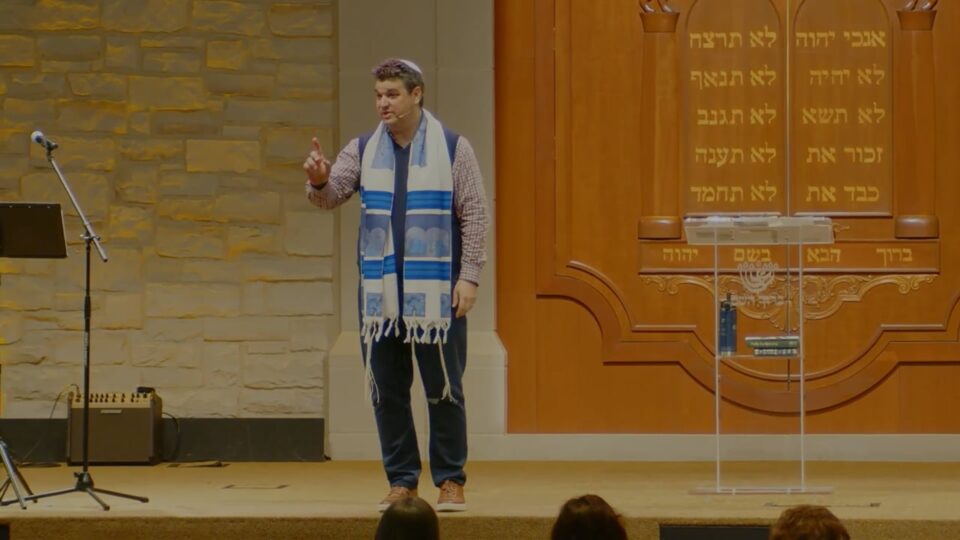
12:37 So every week, we remember by celebrating Shabbat every week, we remember that the Lord brought us out from slavery. Now, I don't know how many of you woke up this morning and said, it's Shabbat, the Lord delivered me from slavery. But it is there in the text. Maybe you're like, well, those are just things on the calendar. What about the stuff that God tells us to do? Well, if, if you're looking for commandments, I, I would assume that the most important ones would be the 10 that are listed right behind me. The 10 Commandments are the most important of all of the commandments.
13:24 And if that's the case, the 10 Commandments start like this, I am the Lord who brought you out from the land of Egypt out of the abode of slavery. In fact, God's relationship is defined by what he did, by bringing the Jewish people out from the land of slavery. I don't know if you can quite picture yet, I don't know if this is enough examples for us to realize that this is a really important story, perhaps the most important story for us as a people ever. There's another picture that's associated between the relationship,
14:13 uh, that's associa that's connected with the relationship between the Lord and the people of Israel. And that relationship is often described through the prophets as a husband and a wife. In fact, nearly every prophet Refers to the people of Israel as a wife gone astray, selling herself to other gods, sometimes not even selling herself, but actually paying to go to the other guides. We see in Jeremiah chapter 16, Verses 14 and 15, it reads as follows, therefore says,
14:59 [unknown] The day will come when people will no longer swear as Adonai lives who brought the people of Israel out of the land of Egypt. But as Adonai lives, who brought the people out of the land of the North and out of all the countries where he drove them for I will bring them back to their own land, which I gave to their ancestors. This passage indicates that there will be a day when the Exodus will no longer serve as the standard to measure the Lord's redemption because there will be a redemption far larger and far more significant.
15:46 How is that possible that there's a redemption more excessive than drawing us out from slavery in the land of Egypt? How is that possible? Well, how about the reemergence of a people that had been scattered throughout all of the nations for 2000 to 2,500 years? Has there ever been another people group that had been scattered and returned to their homeland after 2000 years? Has there ever been another language that has died and returned to back to life after 2000 years?
16:33 Listen, I studied Latin in high school. There's a reason it was dead. Have there ever been more miraculous stories about a particular singular group of people coming out from the nations and being returned to their homeland? I think of just an, uh, uh, of a few coup, uh, uh, a couple examples here. Operation Moses, operation Joshua, operation Magic Carpet, or also known as Wings of of Eagles Operation Ya, operation Ezra and Nehemiah. These are all operations which brought the people of Israel back to the Land of Israel. By the way, if you wanna watch a good movie now, I know,
17:21 I, I recognize I'm going out on a limb here by recommending a movie from the stage, and it's an r-rated movie. I'm pretty sure it's R-rated, but it's called Red Sea Diving. And, uh, red Sea, uh, wait, hold on. Red Sea Diving Resort. It's on Netflix. It's got Captain America in it, so it's gotta be good. But it's about, it's loosely based on the operation of bringing the Jewish refugees that were, uh, refugees from Sudan, and that Israel set up a base on the, on the Red Sea and quietly smuggled thousands of Jews out and back to Israel is a,
18:08 is a fantastic story. And there are so many stories of this. In fact, I was talking to someone in the last week, and I can't remember who it was, but one of these is, it's amazing to me, the, uh, operation Magic Carpet or Wings of Eagles. It's the operation where they brought Yemenite Jews back to Israel, Yemenite Jews. They were so isolated, they had never seen anything like an airplane. And there was a, there was a beginning movement to go back to the land of Israel, but they knew the scripture where it said, the Lord will bear us up on wings like eagles. And so the leader said, we're not going until the Eagles carry us back. That is the weirdest thing. Like, how am I gonna wait until like a,
18:56 an eagle is gonna carry tens of thousands of people. It's not possible. And then Israel sent in a couple, uh, uh, cargo airplanes, air Force cargo airplanes, and they began a, they began a, a cycle, and they would fit hundreds in the plane at a time. And the leader said, yes, this is, this is it because we're being born up on wings of Eagles. And so he said, yes, and the people left. I mean, they also lit fires in the, in the back of the airplane while flying. But not necessarily a safe thing to do while you're flying. But when have we ever seen any sort of
19:43 redemption like that? And all of this occurred within many of our lifetimes. It's not that this is ancient history. If you were born prior to 1948, you have been witness to all of this. In fact, the north, the north country opened its doors in the early nineties and millions of Jews came back. These stories represent the beginning
20:28 of the fullness of what Yeshua is talking about here in Luke 22, 2000 years ago, Yeshua took the cup. He offered a broccoli, he offered a blessing, and he said, take this, share it among yourselves for I tell you, I will never drink of the fruit of the vine from now on until the kingdom of God comes. He uses this term, and it doesn't show up here, but it's in the passage and it's implied. But this, until the kingdom of God is really this implication of the fullness of the kingdom of God. I know I've said this phrase multiple times, but the kingdom is already here, but it's also not yet. So it's here in seed, but it's not yet in full.
21:17 So Yeshua says, you're not gonna see me again until the fullness of the kingdom of God is here. It is interesting because I, we don't often, when we're reading scripture, think about what I would call fleshly things like the fact that they're sitting around having a meal, that they have a full glass of wine, that they have a full table of food, that they're eating to the point where they will become full. And Yeshua is talking about this fullness here, and perhaps the cup is full. Perhaps he's speaking about the fullness of the coming of the kingdom of God. When would that occur at God's appointed time or the fullness of time
22:09 as we know it, they could be getting full as they're eating. They could be a fullness in the room. I don't know if you've realized this, but they are in a room and there's at least the 12. And I would presume that there's a, there's also, um, several of the women with them as, as well. Um, and the reason I make that presumption is because by the end of Luke, when the women go to the tomb, they come back and say, it's just as he said it would be, Which means that they heard him say it. Well, at least that's what I would take that to be. So I would presume the room is kind of full. In fact, this, the, the, the guest room that's used here in this terminology is the same word
22:55 that's used to refer to the room that was full when Miriam was pregnant and looking for a place to give birth. It's the same guest room, room. It's, I mean, the same terminology. Libe is probably not the same room room, but it's the same name for the room, if you will. Perhaps Yeshua is beginning to bring a fuller or more full understanding to the Seder at this moment. Maybe that's why it looks a little bit different, knowing that the fullest understanding of the, of the Seder wouldn't occur until the future when the Lord would bring his people out from the land of the north and the other
23:44 countries of the world. As Jeremiah describes, Yeshua moves on and he says, when, uh, when he had taken the cup, he offered a brca, he says this, I know I've read this verse three times now, but sometimes it takes us three times to to hear something. Take this, share it among yourselves, for I tell you, I will never drink of the fruit of the vine from now on until the kingdom of God comes. Now, I heard my father say something at sh at Pentecost that I have never heard before, and it struck me as a fantastic insight. He said, what Yeshua does here is he takes a Nazare vow.
24:35 He's not going to drink wine until the king, the fullness or the kingdom of God comes. So let's just, I wanna walk through the elements that are in, that are entailed within that. First of all, uh, the Nazare vow, all of those things are listed in last week's tour portion. So it's should be on our minds. What's the purpose of the Nazare vow? It's the purpose is for a person who desires to be separated to the Lord, they make the vow, in other words, that they can draw closer to the Lord. In fact, it's a marker of the firstborn men of Israel. But those firstborn men of Israel are redeemed by the Levis and the
25:21 Levites take their place as separated for the Lord. So what, what's the duration? The duration is whatever the set time is, it could be any length, but it's until the time is done. So it's limited by whatever the time allotment is of the vow. So we see here in Yeshua, it's limited by until the kingdom of God comes, that's when the vow will be fulfilled. In numbers chapter six, this is where we find, uh, the, the limitations for the Naza rights. It says chapter six, verse four through eight. All during his days as a Nazarite, he is not to eat anything from the grapevine. So here, number one, he's not to eat anything, grapes, grape related,
26:07 all the duration of his nazarite vow, no razor is to come on his head. In other words, he is not to cut his hair, uh, or his beard until the time of his consecration. To the Lord is over, he is to be holy. And the hair of his head is to grow long, all the days of his separation to the Lord, he is not to go near a dead body. So here's the third one. You're not to go near dead bodies, even if his father, mother, brother, or sister should die, he is not to make himself unclean because his consecration to God is on his head. All the days of his separation, he is to be consecrated to the Lord. So no, why no haircuts, no dead bodies. Those three things allow the person who takes the vow to do something in
26:54 particular, it allows him to be consecrated to the Lord. These laws of the nazare, of the, of the Nazare vow, they mirror, they parallel the laws of the, of the priesthood service, the, the priests who are in service, not necessarily, um, the priests who are outta service, but those who are in service. And if you are using the, the u version app to follow along with the notes, I I put a video in there that you're welcome to watch by, um, olive Beta. It's a fantastic video on the nazarites, and, and you'll hear all of this, uh, in, in that video. But the Nazarite vow, what it does, it allows a common Israelite to draw near to the Lord like the priest do, but not a pr, but they're not a priest.
27:43 It doesn't make them a priest. It draws a ear like a priest, uh, in regard to having a special individual closeness with God. In fact, I, I recommend that video because it gives a, a qualification, uh, which I'm not going to get into. But there's another, there's another person who wants to be like Moses, like Aaron, like the priest, and he happens to be their cousin Cora, except he doesn't wanna be near to God. He just wants to be recognized in the position of honor. And, and they go through that in the video. You go watch the video. It's a great video. So I find it fascinating because number one,
28:30 Yeshua is not a priest of not born a priest, I should say. He's not from the tribe of Levi, but he takes this vow, and where's Yeshua going To be closer to God? He's gonna draw near to God. In fact, Luke says at the, at the end of Luke 22, that he'll be sitting. In fact, Yeshua says this, he, he will be sitting at the right hand of the power of God until when, until his vow is done and his kingdom comes in full. And while he's there, he will not drink wine.
29:17 Now, I don't know what kind of wine they have there, but this sounds like if he's missing out on, if he's missing out on earthly wine, I just imagine what the heavenly wine is like. It was a joke. You guys don't have to laugh. Let's move on In verse 19. And when he had taken the matza and offered a braca or a blessing, he broke it and gave it to them saying, this is my body given for you. Do this in memory of me. In the same way he took the cup after the meal saying, this cup is the new covenant in my blood, which is poured out for you. But look, the hand of the one betraying me is with mine on the table. For indeed, the son of man is going as has been predetermined,
30:06 but wo to that man by whom he is betrayed. Yeshua is saying very clearly here that he's enacting a new covenant through this matza in wine. Well, I, we talk about the new covenant all the time, and I think it's important to start with the origin of the new covenant so we don't get misguided. So you can, you can turn or you can use your Bible, uh, use your app, whichever one you want to. Jeremiah chapter 31, Jeremiah 31 says this, verses 30 through 36,
30:52 behold days are coming. It is a declaration of the Lord when I will make a new covenant with the house of Israel and with the house of Judah, not like the covenant I made with their fathers in the day I took them by the hand to bring them out of the land of Egypt. So you see, again, there's reference going back to this origin story of coming out of Egypt. For they broke my covenant, though I was a husband. To them, it is a declaration of oai. But this is the covenant I will make with the house of Israel after those days, it is a declaration of oai. I will put my Torah within them. Yes, I will write it on their heart. I will be their God, and they will be my people.
31:37 No longer will they teach his neighbor, uh, no lo no longer will each teach his neighbor or each his brother saying, no, the Lord, for they will all know me from the least of them to the greatest. It is a declaration of oai, for I will forgive their iniquity, their sin. I will remember no more. Thus says Oai, who gives the sun as a light by day in the fixed order of the moon, in the stars as a light by night who stirs up the sea. So it's waves roar, AEs of a oat is his name. Only if this fixed order departs from before me, man, he says, it is a declaration of the Lord. Often in this passage,
32:24 it is a declaration of the Lord. Only if this fixed order departs from before me, then also might Israel's offspring cease from being a nation before me for all time. Thus says, I don't know, only if heaven above can be measured and the foundations of the earth searched out beneath, then also I will cast out the offspring of Israel for all they have done. It is a declaration of the Lord. So what's happening here? There's a new covenant who's a new covenant with the house of Israel and the house of Judah. Why is there a new covenant? Because they broke the old one. So what is the new covenant? The new covenant is this, his Torah will be written on their hearts. They will all know him,
33:14 their iniquity will be forgiven in their sin forgotten. And the people of Israel will continue to exist until the fixed order of the heavens and the earth depart from before the Lord. I mean, those, those are strong words, but th this is what the new covenant is. How is it enacted? Yeshua enacts the new covenant here with the matza. In fact, we associate it with the breaking of the AFI Komen, when the Afi Komen has, has been buried for three days and it comes back out and it, and it appears in the meal. Everything has been eaten. And now it's time for the AFI Coleman in his tradition that the AFI Coleman is
34:01 the last, uh, taste of food that resides on your lips and is dessert. It's supposed to be sweet. Now, I I'm not sure what kind of dessert the rabbis were thinking of when they said matza, but it's not my favorite dessert. But let's just, the story still stands. It's supposed to be sweet. You have to kind of almost imagine the sweetness unless it's gluten free, then it's kind of sweet. The matza sits there and this is the enactment of the new covenant. And then Yeshua raises the glass. The what we would now recognize is the third glass, the cup after the meal in our, in our modern format. This is the cup of redemption. And he offers the blessing.
34:48 And what he's doing is he brings a fuller understanding to the elements of the Seder here, both for his followers and everyone to follow. So here in Luke chapter 22, this is actually where we get, uh, the practice of communion. It's the passage. Uh, this is why when, when you have communion in, in churches, uh, that the bread is first and then the wine, they just forgot to read the verse before, which is the wine, the bread, then the wine. But I will say it's, it's good to be able to wash it down. You guys always see me try to come up and make announcements after having a piece of bread. It's really difficult to talk.
35:37 But there, there is a connection between communion and Passover that is often forgotten. In fact, it's often ignored. And thereby, if the, if those are, are disconnected, then actually the connection to the exodus and the coming kingdom is also either ignored, forgotten, or misappropriated in, in a, in a wrong way. Let me just take this moment and share a caution. It is not limited to Christianity. Um,
36:25 but it has happened most often in Christianity. There has been what is known as the blood libel, which is an accusation against the Jewish people for kidnapping children from whatever na neighborhood they are in taking them and using their blood for the Passover sacrifice. In fact, because of this accusation, many pogroms wars, all sorts of things have started in, in, in a lot of Jewish life has been lost. I just want to say the accusation is false, like a hundred percent false. It partially can connect here
37:12 to this passages where Yeshua says, this is my blood. But the reality is the Torah forbids us from drinking blood. In fact, you, you think, well, that's something that could only happen in the Middle Ages. Like I not in our modern society where we are an enlightened people and we have tolerance for everyone. The accusation continues today in a variety of forms. Let me just give you a quote from one official Palestinian TV show. What do the Jews want from us? Why do they continue to kill small children?
38:01 If you want the article I gave you the article in, in the, in the u version notes a link to the article, but it's not the only time. It happens all the time. Now maybe it's disguised as something else, but it's, it's pretty common. Let's move on here In this passage, Yeshua says, but look, the hand of the one betraying me is with mine on the table. For indeed, the son of man is going as has been predetermined, but wo to the man by whom he is betrayed. Let's,
38:46 I wanna break this down for a moment. Have you ever shared a meal with anyone As Pre is pretty, like when you're sharing a meal with someone, you're like, oh, your your hand's on the table with mine. Like, how come the disciples didn't go at this moment? Look at Judas, his hands on the table with Yeshuas because all of their hands are on the table with his, you see in this society. And I, and I tried looking for a picture to find something relevant today. And, and, and the best way I can describe this is one of two ways. If you've been to Israel and you've sat and had a meal in a bed of intent,
39:34 or if you've been to Ethiopia and you've sat and had an Ethiopian, a traditional Ethiopian meal either in Ethiopia or here, the meals are relatively similar. You see, we don't, they don't eat with forks and knives. In fact, in Ethiopia, I was in Ethiopia a little over 20 years ago and we're having a, a pretty traditional meal. And in Ethiopia, you eat only with your right hand because your left hand is used for other business. We'll just leave it at that. So you eat only with your right hand. So in fact, actually, and you,
40:20 you always eat reclining, so you're, you're reclining. And, and so it would just seem n natural, like you're reclining. You put the one hand down and, and everybody's eating. And Let me just take this one step further. We went out, there was probably four or five of us who went out for Ethiopian. Dave, what was that, A week or two, two weeks ago. Two weeks ago, Dave was one of them. We're there, I ordered this, this tray of food because it's a tray. We're not sitting on the ground, but we're sitting at a table. Well, I'm just gonna tell you from the moment that that tray arrived until the moment where it was all gone, if I were to say the one who has his hand on the table with mine,
41:09 it would've been all of us because all of us are eating. In fact, when you, you think about it, when you're trying to break bread, if you can't use your other hand because you use it for other reasons, then it requires someone else to break your piece of bread so that you can eat. So all of their hands are in the communal pot, if you will, the communal dish. And Yeshua says, the one of you with his hand in here is gonna betray me. Uh, every single person is probably going Get my hand outta that dish. In fact, Peter even says, well, this is, I know I'm jumping ahead to next week.
41:56 Peter says, not me, Lord. We'll, we'll talk about that next week. But you can imagine that they're all there and they're all of a sudden they're like, wait a second. Who's it gonna be? Is it me? Am I gonna be the one who betrays the Lord? And Yeshua says, this has been predetermined. It doesn't matter if you do it or not, but whoa, to the person who does it when you eat a meal this way. In fact, I would,
42:42 I would challenge you to go try to eat a meal this way with a group of people, because when you eat with one another and you're literally eating with each other's hands, you become far closer in relationship to that other person, whether you intend to or not. It just begins to break down barriers. And in fact, that's really what eating together does, even if you don't eat that way. But when you have a, when you have a meal like this, what it does is it creates in you
43:29 what I would call and what Pixar calls a core memory. And when you have a core memory, anytime for the rest of your life that you, that you have something similar, it takes you back. So even today, when I go eat Ethiopian or when I it, it will take me back to a particular instance. Or when I eat barbecue, I know I talk about barbecue a lot when I eat, when I talk about bar, when I eat barbecue, I have a core memory from when I was 15 and I cannot remember the place. And if I could, you better believe I would be there every day of the week because that is what I
44:17 measure every barbecue place against. But it takes me back to that place. And this is what happens when you have a core memory. You have a it, it goes back and you immediately, you have the smell, the taste, almost the full memory as if you were there, but you're still in this moment. And this is what Yeshua is doing with his disciples, is he's creating a core memory. He's been waiting to eat this Passover. I'm sure he's already had several seders with them, but he's been waiting to eat this one because now he's setting a fuller meeting or he's instating a fuller understanding into the Seder,
45:06 but not yet the fullest. You see what's happening. He's setting the stage for what will be he's been with, what has he then takes it to what is, and he shows what will be The fullest expression. And so then every time he says this, every time you have this meal, every time you eat in memory of me, every time you do this, this is the way you're to feel. This is what you're to have. He's creating a core memory for them. Every time you do this, this is to draw you back to here so that you can then look forward and see what will be. In fact,
45:52 Paul says it in, in, in Paul's letter to the Corinthians, he's actually quoting Yeshua. He says, for as often as you eat this bread and drink this cup, you proclaim the Lord's death until he comes this meal. This particular meal has the strongest memory in the history. My notes say of the Jewish people, but really in the history of the world because the memory is tied to freedom from slavery from Egypt. And now it's tied to Yeshua's atoning work that he's about to do. And it's tied to his enactment of the new covenant,
46:41 the instatement of the new covenant. And so every time they ate this meal, at this point once a year, I recognize in, in, in church's communion has done more often. But how often is this Seder done? Well, unless you do like 12 in in the week, uh, it's done once a year. You do Seder once a year. And they remember this moment every time. And I imagine, I don't know this because it doesn't say it in the scripture, but I imagine until the apostles died, they always went back to that one meal. Every time they sat and they ate together. I imagine they went back to that moment because they created a core memory with Yeshua.
47:26 Every time they tasted the Lamb of the Seder, every time they tasted the dessert of the matza, they remembered the sights, the smells, the, and even the joys of their evening, their, their last Seder with their master. Because something like this would not occur again until Yeshua returned with his full kingdom at hand. Why do we know that? Because Yeshua's Nazareth vows says this will not happen again until, until my kingdom is here in its fullest.
48:15 So let me, let me wrap it up with this, a couple questions. What does the Seder meal mean for you and me? Do we see the fullest expression of it in Yeshua, our Messiah? Are we waiting expectantly for the day when his Nazarite vow will expire and he will drink and eat with us in celebration of the fullness of his coming kingdom? Is that what we're waiting for? Or do we just eat it and we don't think about it? If that's not what you're waiting for, let me challenge you to dig deep.
49:00 Let me challenge you to begin to long for the day when Yeshua comes again. Let me challenge you to be prepared for the day when he comes. Let us not be caught sleeping more ill prepared, but let us keep watch expectantly as we are waiting and hoping for his soon and swift return, a our Father in heaven. Lord, I thank you for this, for your word which came Through The scribing of Luke, Lord, Lord,
49:45 and for the the example, the explanations that Yeshua gives. Lord, I thank you for your covenant with your people, which you have expanded and brought in the nations. Oh Lord, Lord, I pray that you would cause us to follow you to walk as Yeshua want all of our days. Lord, We bless you and praise you in Yeshua's name a may the Lord bless you and keep you.
50:31 May the Lord make his face shine upon you and be gracious to you. May the Lord lift up his countenance upon you and give you peace.
51:28 [unknown] in the name of our Messiah, Yeshua.