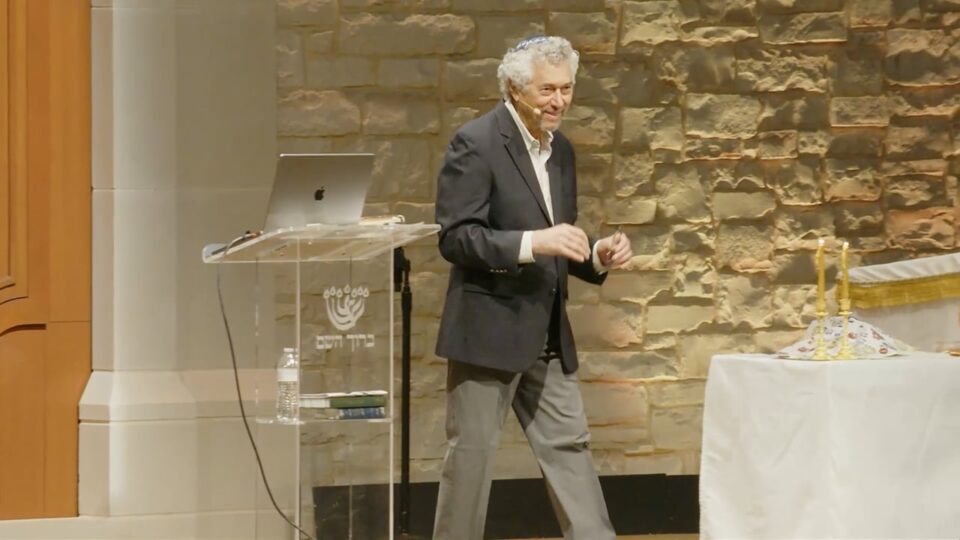

Message
Rabbi Marty Waldman•Luke 22:39-46•June 24, 2023
Timestamps seek whichever format is playing — video or audio.
0:00 So last time I led service, I had the wonderful opportunity to introduce Rabbi Ari before he brought us this message. And I would say that is a privilege. I would say this one is equally, if not greater, because I have the opportunity to introduce Rabbi Marty, who I first heard preaching this congregation two, 2008. Father, we come before you, just thanking you for the opportunity to be in your house and to listen to your word. Father, I pray that as you have done over many years,
0:47 that you would continue to speak through Rabbi Marty, father, that you would use him mightily to proclaim your word boldly, as he always does. Father, give us ears to hear, hearts to listen, and the desire to obey. Thank you in the mighty name of your son, Yeshu, we pray. Amen. Thank you, Marcus. Thank you for that gracious introduction. Shabbat shalom, everyone. Good morning. Well, it's been many years that I've lived on this earth, maybe,
1:35 and over these years, my, you know, I'll, I'll be a little more biblical cuz God's listening. Um, Over this short lifespan that I've lived so far, I've learned a few things. One, that brain cells die. I also learned that skill, uh, skin cells die. I also learn even hair cells die. But this is what I really don't understand.
2:24 My fat cells must have accepted Yeshua and been given eternal life by the way that Ari always chis me, always kids, me, about starting up my messages off with a joke. So I was determined not to do that this morning. But then he sends me a joke. We're gonna be looking at a, uh, passage in the book of Luke, Luke in a continuation of the series that, uh, rabbi Ari started through the book of Luke. It's gonna be Luke 22
3:14 versus 39 through 46. Just a, a little short passage I'm reading now from the New American Standard, but later on I'll read some from the complete Jewish Bible. And he came out and proceeded as was his custom to the mound of olives. And the disciples, the tamad deem also followed him. And when he arrived at the place, he said to them, pray, pray that you may not enter into heart testing or temptation, as some versions say.
4:01 And he withdrew from them about a stone's throat. And he knelt down and began to pray saying, father, if you are willing, remove this cup from me, yet not my will, but yours be done. Now, an angel from heaven appeared to him and strengthened him and being in agony, he was praying very fervently, and his sweat became like drops of blood falling down upon the ground.
4:49 And when he rose from prayer, he came to the disciples and he found them sleeping from sorrow and said to them, why are you sleeping? Rise and pray that you may not enter into hard testing or into temptation. Lord, we just ask your blessing upon your word, and we ask you to speak to us on this Shabbat day. Ba Yeshua. Oh man,
5:36 I wanna just start off this message today with a, by the way, this is a disclaimer, but if you don't like the message, you know, I'm just a messenger. I'm just a delivery guy. I started hearkening back to many years, gone by when I was, uh, before I was married, before I came to know Yeshua. And I was what some people called a hippie. Some people don't even know what that is anymore. It was back in the 1960s. But now I'm focusing in on sort of the late 19,
6:24 later 1960s. So back in the days of my youth back then, I started to ignore my Jewish upbringing, my Judaism. I stopped, basically stopped going to synagogue every once in a while to go for a holiday or something, but basically stopped going. And I st I sought spiritual fulfillment in other places doing other things. I won't tell you all those different ways I've sought that, but just suffice it to say that I turned in a different direction away from God. I would say, looking back.
7:09 And during that period of my life, I fell in with a group of musicians and we formed a band. But let me, let me backtrack just a second. Before we formed this band, I had this dream. I had this dream to Dr. Drive up to New York on a motorcycle. And so I ordered a motorcycle, brand new motorcycle.
7:56 I was probably 18 or 19, probably 19 years old, something like that. It arrived, I took it to a chop shop. And uh, you know, back then the movie Easy Rider was a big thing. Some of you don't even know what that is, but that's okay. So my motorcycle was ready, and then I was ready, I was prepared to go up to New York, but I was supposed to go with someone else who also ordered the same motorcycle, but he was going with a girl who would later become his wife. And she was very upset about him driving across country from Southern California all the way to New York.
8:44 She was very upset about him doing that, especially with me. So, so he backed out, he canceled his motorcycle order, and I was left alone. And my, and my decision was, was I gonna drive all the way up to New York by myself on a motorcycle that, that had been chopped up, you know, and chopped, you know, like the front end raked out and handlebars high up, you know? Anyway, and I, I decided, you know what, I'm chickening outta this. I didn't want to drive all the way up there by myself because part of the movie,
9:31 easy Rider, they, they drive through the south and they get shot by southerners because of the way they looked with long hair, et cetera. And I thought, Hmm, I don't think I'm gonna try that. So my dream was not just to drive to New York, but to drive to New York for a purpose. I wanted to be part of what was touted as the greatest rock concert ever, to be held on the face of the earth called Woodstock stock. I didn't make it.
10:16 Circumstances, as I just explained, prevented me from going. But I later fell in love with a song that had been written by a very exceptionally talented musician named Joni Mitchell. I don't know if any of you have heard of her or heard her sing, but she also was invited to Woodstock as a musician. But she opted to go to do a TV show rather than to go to Woodstock. She probably reread it after that. But she watched clips from Woodstock on her, from her hotel room
11:02 in New York and wrote a song about Woodstock. And actually her song is called Woodstock. Woodstock. For those of you who don't even know what Woodstock is, it was a gathering of about a half a million young people, A number of them hippies, others budding hippies would be hippies. Lots and lots of musicians. Musicians who became very famous because they played on the stage at Woodstock. It was three days of music, day and night. It sounds glamorous, but it wasn't, it started to rain and it was terrible.
11:51 I mean, muddy, rainy. Anyway, it, it, it sounded terrible to me. I didn't like camping anyway, but like myself, there were about a half a million young people who were seeking for God all in the wrong places. Some of you can relate, but listen to, listen to some of the lyrics. I didn't write the whole song out, but I wrote some of the lyrics I felt would be a little more pertinent to Joni Mitchell's song, Woodstock, besides the lyrics. It's a beautiful song. She has a beautiful voice.
12:40 I came upon a child of God, he was walking along the road and I asked him, where are you going? And this, he told me, I'm going on down to Jasper's farm. I'm going to join in a rock and roll band. I'm going to camp out on the land. I'm going to try and get my soul free. And then she sings the chorus. We are stardust, we are golden, and we've got to get ourselves back to the garden.
13:26 She's not a religious person, Joanie, she, I didn't necessarily even grow up in church or, But she refers back to the garden, of course, the Garden of Eden. And she then expands her chorus. We are stardust, billion year old carbon. We are golden caught in the devil's bargain, and we've got to get ourselves back to the garden. So I've entitled my message today back to the garden,
14:13 not the Garden of Eden, but the Garden of Gethsemane. That's the point that Joni Mitchell missed. She wanted to get back to the Garden of Eden, even though she knew that humanity was ensnared in the devil's bargain. When you get ensnared in the Devil's bargain, what good do you think it's gonna do to get back to the garden? Well, I'm gonna get my soul free. Oh, how you gonna do that? Well, I'm gonna take enough L s d, I'll smoke enough pot,
15:00 I'll make enough money. None of those things affect the soul. That was the problem with that philosophy. I bought into that philosophy when I was that age. I loved the song. It was one of my favorite songs, especially since I couldn't make it to Woodstock. But I became discontent enough and something things were happening in my life that Drove me to seek spirituality because I was discontent,
15:46 drove me to seek the Lord. Now, don't forget, I grew up in, in Judaism. We were, we were traditional Jews. We went to synagogue all the time. You know, I was circumcised on the eighth day out of Bar Mitzvah when I was 13. I went to, uh, what we call hater or yeshiva for seven years in my younger years, it's not that I was scholarly or magnificent in Hebrew or anything like that, but I be, I grew dissatisfied. There was something in me longing for more.
16:39 And so I found myself being introduced slowly and in strange ways to someone named Jesus. Listen, I grew up, that name was never mentioned in my home unless it was a curse word. Never. So anytime that name was mentioned to me, even during this seeking period of my life, I wasn't interested. Jesus was the God of the Christians. We Jews had nothing to do with him. And you know, I want you to know something. Every time the name of Jesus or Yeshua is mentioned,
17:28 even people who are not practicing Jews all of a sudden become very Jewish. Even me, I remember Marlene's mom, right after our first child was born, Sabra. She said, Marty, the only way you're gonna have any peace in your home is you have to believe in Jesus. And I said, look, I love you. I thank you for your desire for me, but I'm Jewish. She was not,
18:17 but that was my excuse. How do I know that was my excuse? Because every time you read the gospels, every time you read the Book of Luke, almost all if not all, almost all of the people talked about in the gospels are Jewish. All of the followers of Yeshua were Jews, all of them, without exception. Later on the door opens, started to open up to gen, to the gentile world or to the nations. And Luke, of course, you've heard Ari share this many times, it's debated whether Luke was Jewish or not, or Gentile. And um,
19:04 I'm not entering that debate. It's not my part of my message today, but sometimes I think he's gentile. He and he's a convert to Judaism. Other times I think he's Jewish because he's a doctor. So we, we are in, we are in Luke chapter 22. Let's see if I can get this thing going. How about it? What am I doing wrong? The power's on. Huh? Oh, it's up there. Okay. It's not on here. There we go.
19:53 So we're talking about Back to the Garden. And this takes place, it doesn't even mention in those few verses in Luke that we're focusing on, but it does talk about the rest of Luke 22 talks about the Seder. They're, they're going through the, the Pesach Seder. And so I'm going to just bring it up in context. These verses we're focusing on in Luke 22 verse, I'll just start in verse one. I'm not gonna read the whole thing, but, but the festival of Matsa known as Pesaf was approaching and the head kohan name the head priests
20:40 and the Torah teachers began trying to find some way to get rid of Yeshua because they were afraid of the people. Now, they weren't trying to get rid of Yeshua because they were afraid of the people they were trying to find some time that wasn't at this moment. Cause they were afraid of the people. The people loved Yeshua, and they were afraid to do anything against him because of a backlash that might come out from the, from the crowd. But the point is this, at that time, the head kohanim and the, and the Torah teachers. So the heads, some of the heads of Judaism in that day,
21:26 were trying to find a way to get rid of Yeshua. This is Luke other gospels that mention this story. And they all, do all four gospels mention this story. Um, some, some of them say they tried to kill Yeshua, but the main thing is they tried to get rid of him. Listen to this verse three. At this point, the adversary went into Yehuda from Creo, Judas Iscariot. I wanna stop here for a moment. And the reason I'm emphasizing this just for a moment is because there's a l
22:12 that things happen in a certain time period. Uh, and things become ripe at a certain moment. And we need to be able to recognize that. So the devil comes into Judas. There was no reason for the devil to come into Judas at that time, other than it would serve the devil's purpose. Because the leaders of the Judeans at that moment, were trying to get rid of Yeshua. We need to keep our eyes open and recognize the timing of things,
22:58 recognize the timing that we are in, but recognize the timing. Now, the other gospels prolong this a little bit more. Luke, as Ari has mentioned, numbers of times, Luke from the outset, from the beginning, said he was writing an orderly report about what happened with Yeshua. Orderly means it's almost chronological and systematic. Keep in mind, Luke was not present with Yeshua when Yeshua was alive. Luke wasn't there. He didn't see any of this stuff taking place in the garden.
23:45 He didn't see Yeshua at the Seder. He, he, he, he wasn't there. What he's reporting and what's in Luke's gospel is, is representative of him gleaning the information from those eyewitnesses who were there. So when he's writing a more concise, a little bit less personal accounting of Yeshua's life, death, and resurrection. So he writes the timing, the leaders were trying to get rid of Yeshua. At the very next verse says,
24:35 at this point, during this timing, at that point, the adversary, Satan, the devil, went into Judas Yehuda from Creo, who was one of the 12. So he got to an inside man, got to an inside man. You know, this happens so often. It's like when Israel was wandering through the wilderness. We're coming up on this Torah portion. We haven't gotten there yet, but it's, we're coming up on the Torah portion, Blac, When we, we are introduced to Balaam, you know, the so-called prophet Offit.
25:20 And Bak hires him to come and curse Israel. And he and he, he goes up three times to curse Israel. And finally, BAK is so mad at him cuz he never curses Israel. God says, I'll kill you if you curse Israel. And, um, and he says, why? I've, I've paid you, you've gone up three times. Why didn't you curse Israel? And he says, I can't curse what God is blessed. So the cursing couldn't come from the outside. Just made a, make a mental note of this. What happens is that the cursing comes from corruption on the inside more often than it comes from the outside.
26:09 And it's true in this story. It was true in that day with Israel. Some of the people in today's Torah portion, you'll see some of the people left under Cora, rebelled, others you'll read in the Torah, went over to the adversary side and started having sexual relations with their women and even brought them back into the camp. And this was corruption from the inside. And it was really hurt Israel in a bad way. But that's how it happens. So, you know the story of Judas, I don't have to repeat that story to you.
26:57 He took money to, to what some people call, give Yeshua the kiss of death, pointing out who Yeshua is by kissing him. So when they came to the Seder, they all reclined. And Yeshua said, I have been really wanting so much to celebrate this Seder with you. He is speaking to his Tom Deemus disciples before I die. What? You're gonna die. He's only 33 years old. Come on. I want to celebrate the Seder with you before I die. You should always telling them what's about to happen.
27:49 And as Ari mentioned, I can't, rabbi Ari mentioned last week or sometime before that, um, Yeshua said, I'm not gonna drink any more wine. This, this is, this is it. This is the last Seder. Some people call it the last supper. This is the last Seder. And I won't drink any more food of the vine until we get together in the kingdom. When the kingdom comes. I concluded by that at least questioned that perhaps Yeshua, even at that point was making a Nazarite vow not to not to drink any fruit of the vine until he, until his return.
28:37 And when he returns and the kingdom of God comes with the king, There's gonna be a party. So of course, every time we, every he, he gave us this, what we now call the Lord's Supper, the Eucharist, the communion. He gave this as a memorial. Every time you do this, remember me. So he says, the person who's betraying me is at the table with me. Rabbi Ari's gone over all this. I'm just catching up. He says, you know, woe to that man who does this, who who who actually betrays me.
29:27 Of course the disciples go into a big argument, who's the greatest. But really what was on their mind was, who's the worst? Who's gonna betray Yeshua? Not me. I'm the greatest. Wow. We, our egos swing like pendulums. So Yeshua says, you are the ones who have stayed with me throughout my trials. The ones who are left, apparently I, Judas is now gone. Even though Luke doesn't talk about it. He says to Shimo the adversary, the devil, Satan.
30:15 I'm reading off a piece of paper cuz I copied the scripture, I printed it off. And with, with large print, the adversary has demanded to have you people for himself to sift you like wheat. He's addressing Simon, he's addressing Shimon. But he says, he is asking plural, he's demanding, plural, to sift you plural like wheat. He says. So Simone responds and says, oh Lord, I'm prepared to go to prison for you. I'm prepared to die for you. And Yeshua says, Hey,
31:00 before the rooster crows in the morning, you're gonna deny me three times. Not me Lord. So when he did, when he had that experience and he heard the rooster crow after denying Yeshua three times, I don't even know him, he wept out of conviction because he remembered Yeshua's words. I love Rav Shaul words in Romans chapter one. I am not ashamed of the good news. The gospel for it is the power of God for salvation
31:48 to everyone who believes to the Jew first and also to the Gentile. But these young disciples, young tdi, Weren't quite ready. And some of us aren't quite ready either when the world turns to us and says, are you one of those followers Of Jesus, of Yeshua? I don't even know the guy, not me. You must be thinking of someone else.
32:34 Be prepared cuz it's coming. I, But Yeshua said in the end, not only that, he was counted with the transgressors, he will be counted with the transgressors. But he says, what is happening to me has a purpose. Okay? This is sometimes we get, we get tripped up on this. Sometimes when suffering is coming our way, and we can see it sometimes we can see it. It's not always all of a sudden, wow, that caught me off. Totally off guard. Sometimes we can see it coming. And Yeshua saw his coming the moment and he says, what is happening to me has a purpose.
33:24 That's when it's so difficult to remember. God has a purpose for me and my life, even during the times of suffering, during the times of trial and testing. Then we get into our little section, our little paragraph of scripture that we're focusing on today. And as I read this again to you, remember, Judas is not with them any longer. He's gone on leaving. On leaving what? On leaving the room where they were having the Seder in Jerusalem.
34:13 Here, let me advance this. Is there a way that you guys, I don't know if you guys back there can control this, But I'd like at least on my monitor to have the full screen taken up. I've got a little bit of the screen taken up, but not the full screen. Is there a way you can enlarge my PowerPoint? Okay, well that's all right if you can't. So they were leaving on leaving. Yeshua went as usual. I read New American Standard, according to his custom. Uh, it's just that he's, that's where they went. That's the place that he's always went. When he,
35:00 when he was in Jerusalem to spend the night. Not always, but I mean, you know, according to his custom that he developed, he would go to this place that we call Gethsemane or some people, John calls it a garden in his gospel. Um, Luke calls it the Mount of Olives. He went as usual to the Mount of Olives and the Tal Maddi followed him. You gonna try to fix that for me? Yes, sir. Okay, break. Everybody stand up.
35:50 All right, I'll keep talking as Marcus does that. So I want to give you the word in Hebrew for the Mount of Olives. Some of your translations say the, the Mount of Olivet or the Mount of Olives. Um, Some of the other gospels call it the garden. Some of them call it Gethsemane. And I wanna share all those names with you in Hebrew and where they got those names and why. So first of all,
36:37 ha has, which you see up there, for those of you who can read Hebrew right here for if you can't, you read from right to left and it says Ha which means ha mountain ha which is the first letter of the second word. It is just the definite article. The and Za is the plural of olive olives ha haze team, the Mount of Olives. And so what was the Mount of Olives? Some of you have been to Israel, others have not. I'll show you some pictures. Um,
37:22 but it's a mountain where olive trees were able to grow. So Jerusalem and the Mount of Olives were across from each other. In the middle was a valley. It's called the Kidron Valley. And it's, the reason it's called the Kidron Valley is because there used to be, not now, cuz it's modern and they've concreted over it. Now there's a road. But, uh, there used to be just a valley and there used to be a wadi. You know what a wadi is? A wadi is a dry river bed. And uh, but during the rainy season, the water would come off these two mountains that were opposite each other and fill up the wadi and it would flow down this
38:11 wadi. Now it doesn't happen anymore because they've, they're preventing it from happening. And, uh, they've put enough concrete in to stop, you know, there's no wadi there anymore. But there is still is a spring that feeds the mound of olives and that part of Jerusalem, the spring, the hon spring, uh, the water comes out of the ground. So the next word I want you to know is that's where we get the word Gethsemane. Got means oil press sh
38:57 is actually plural, but it's like plural, like water. Like water is shamayim, but we don't say waters. Some people do. But, uh, oil, I could, I could literally say oils press or press oils. Uh, got Is a press, it can stand for an oil press. It can stand for a wine press, it can designate, it's just a press. It, it, it can designate either kind. One of the big, two of the big enterprises that were agricultural in Israel in those days were wine and oil. And if you had an, if you had an olive grove and you were growing olives and you could press the
39:46 oil, you would be a wealthy person because olive oil was not cheap. It was expensive. It was quite a process to press the olives and get the oil out, you know, and, and rid yourself of the skin and the seeds, et cetera. It was quite the process. And it's not like today, you can just put it into, you know, something and electri electrically do it. So, so the Mount of Olives and the, the place where Yeshua was meeting his disciples, disciples followed him. There was called Gutman. And they obviously knew about the place
40:33 the garden referred to in the book of John chapter 18. He doesn't call it the Mount of Olives or the, or the place of oil pressing, he calls it the garden Gone. Simply gone. It's not here now. It's gone. Gone. And Hebrew means garden gone. A den means Garden of Eden. So this became the meeting point outside of Jerusalem. Listen,
41:19 You think it's easy for all of his followers to always stay together and know where he keep him in sight during holidays. So when he, he had a meeting point, he says, okay, boys and girls who were with, he had some women with him too. We'll meet at this meeting point on the Mount of Olives at Gotman name that Yohannan John called Gone the garden. It was probably not the kind of garden you envision, like, you know, a vegetable garden or a flower garden. It was probably more like a grove of olive trees, but it was a cultivated grove rather than wild olives.
42:07 So it would be called a garden. So here is the current gaman, the current place of that we call Gethsemane in Israel, you can see that it's cultivated. It even has, you know, walkways made with rocks so you can walk along in the garden. And this is, this is what they say is the traditional place that where Yeshua met with his, with his tadem. But we don't know that. I mean, not for real. You know, the the first time this garden, this one was mentioned in history, was in the fourth century.
42:55 You can't find it before then. What happened in the fourth century? Well, emperor Constantine of Rome's mother came to Yeshua. I mean, what you read about her seems to be that she had a real experience with the Messiah. So she left her home and journeyed to Israel, she wanted a journey to Israel. She just got so zealous for the Lord. And she, you know, wanted to go and see all the places where he wa where he walked, and all the things that happened there. So she went there and she would walk around and she'd say, oh,
43:41 that's this place. Oh, that's the garden of a Gethsemane. Oh, that's, That's what happened. That's what happened to Mo. That's, that's where we get many of our sites. When you go on a tour, many of the sites come from, oh, that's that place. Oh, that's that place. Well, there was some tradition when she got there. So some oral tradition. So it wasn't completely, you know, offhanded. So maybe this was the place, maybe not, but up the hill, there's another place that, there's another group that claims that their place is the right place. And because it has a, there's a cave up there and they say that Yeshua and his disciples would've
44:29 spent the night in the cave. So they, of course they built, you know, a church around it and just like this place. Thank you, Marcus. So that's Gotman name, garden of Gethsemane. This is a traditional oil press. Of course this one has been fixed up. So, so somebody could take a picture and advertise their oil. If you find you, you can find oil presses in Israel around Jerusalem. But in the, they're just excavated oil presses. They're, they're in ruins. They're not fixed up like this one. You think this is a working oil press?
45:18 It's not. It's just for picture. I mean, yes, it works. They, they, and they do it and they show tourists. But, um, this is, this is what an oil press would look like. So there, there was an oil press, there was an oil press in this olive tree grove somewhere on the Mount of Olives where, where they would retreat. So here's a partial view of the Mount of Olives. And it's taken from somewhere around the eastern gate, the golden gate,
46:03 somewhere around the eastern gate of the walls around Jerusalem. This picture is taken and uh, you can see there's a church. The, this is the church next door to the olive grove that I just showed you. And it, you can see there's a, there's a road down there, buses and cars and taxi cabs, you know, no wadi, no stream. Uh, it's all concrete now. But I wanna show you the topography because you can't really tell from here, you can see that it goes down from one mountain and then up another, but it's only a partial view of, of the mound of olives.
46:49 That mount of olives is bigger than this. So I'm gonna show you this topography. So here's the temple area. Well, let's see, is this working? Let me see. Can maybe it's better over here. Yeah, it's working okay, just kind of don't really get it so much, but you can see, you can read it. So the temple area is that, that place on the first mound in says temple with a line there. And, uh, you can tell there that, um, Herod built a platform. This is not the original, uh,
47:35 topography of the mountain of Mount Mariah. He built, he see all those dots, lines and dots. He filled all of it in. We, we would say, we fill, we would say, now we let's fill it in with concrete. He filled it in with stones and dirt and, and until it was really imp uh, packed down hard. And he made a giant platform. And if you've ever been up now to the area called the Temple Mount, it's a big flat area and it's the, it's Herod's Temple Mount. It's a big flat area right there. This thing needs a battery or something. I don't know. Anyway,
48:21 you can see the Temple Mount and behind the Temple mount going to your left will be houses and buildings and also coming this way, houses and buildings. And in one of the thank you for that era, one of those things, one of those buildings would've been the place where the disciples that Tommy Dean met with Yeshua to have the Seder, not at the temple, but somewhere around, not far from the temple. So they would walk all the way from there, the other side of the temple there all the way down the valley. The Valley of Kidron, the Kidron Valley.
49:07 And then they would walk somewhere up or right there, somewhere around there to their meeting spot, their rendezvous spot. And that would then be called later Gethsemane, the garden on the Mount of Olives. And that's where they met. So you can tell from this that it wouldn't have been an easy job for anyone who was looking for Yeshua to find them. This mountain was, would've been maybe not covered solidly with olive trees, but would've had a lot of trees on it, a lot of olive trees. You know, the ro Romans, when they came in to destroy the temple, they destroyed all the vegetation too. They cut all the trees down.
49:55 So what we have on the, on the Mount of Olives, now we have a, I can go back and show you that picture again. You may not have noticed it. All those Cyprus trees, all those, uh, cedar trees, see that those are not original. In fact, the oldest tree that they could find in the Garden of Gethsemane was from the 12 hundreds that they, that they carbon dated or that they dated. Whereas from the 12 hundreds, we don't even have anything back that goes back 2000 years. The Romans just devastated the place. It wasn't just tearing the building of the temple down. They completely wiped everything out. And Emperor Hadrian, who came just a few years later, He,
50:44 he hated the Jews so much that he renamed. He, he wanted to kick every Jew out and renamed the whole place. And he, you know, he, he, he's the one who named it Palestine. He emperor Hadian Hadrian renamed it Palestine in Jerusalem. He named it Eola Cap. So they, he didn't want any recollection, he wanted everybody to forget. But what does the psalmist say? If I forget you, O Jerusalem, let my tongue cling to my top, to the roof of my mouth. Let my right hand lose its cunning. If I ever forget you as the prize of my heart,
51:33 Jews were never gonna forget Jerusalem, even if everybody else would or tried to. So let me, let me go ahead and get back to these verses. We're done with the pictures. I hope that was a little helpful to understand these verses on leaving, leaving Jerusalem, Yeshua went as usual down the Kidron Valley up the Mount of Olives. And it was not a long, not a short walk by the way. It probably took them about 40 minutes to walk it down and went to the Mount of Olives, and the Tal dem followed him.
52:27 So I want to talk, stop here for just a moment, because now I want to share what I believe is what God may want us to hear today. Maybe he's already spoken to you already in the process, but I, I want to talk about following, following Yeshua from verse 39. Luke 2239, the Tal Medi followed Yeshua back to the garden. So you know what the seder's like, I don't know how far back this tradition goes, but the modern tradition in a Jewish home of, of, uh,
53:15 having a Seder is you have four full glasses of real wine, not grape juice. Well, maybe that's what they meant by new wine, grape juice. I once said this at a, my, one of my very early speaking engagements at a church. They asked me to come and do a Passover demonstration. So I did. Marlene was sitting in the group, you know, kind of halfway back and um, and I started talking about the wine. And I said, by the way, this is real wine.
54:01 This is not grape juice. And Marlene starts going, but I, you know, I didn't quit. I said, it's just like the wine at the wedding at Cana. I said, he turned the water into real wine. He didn't turn it into grape juice. He said, how many of you have ever gone to a wedding to celebrate and had grape juice? I said, in fact, this is the one time of the year that in our family growing up, my family growing up, they used to allow the kids to get sicker. A little drunk. Finally, Marlene's, you know, been doing this the whole time. Finally,
54:50 the, the pastor of the church stands up and goes, my, I want you to know my Lord was not a wine biber. I never said he was a wine biber. He was a wine drinker who bibs wine. I don't know. So the Tal Maddi followed Yeshua back to the garden. And I don't know how much wine they had, but they had wine. And it was, it's tradition in, it's a tradition in Judaism. Again, I don't know how far back this goes to not complete the Seder
55:41 until after midnight. So it was late there were walking back and it was late. There were no streetlights, no flashlights, it was late. There was a full moon, which is good. Full moon on Passover. So he goes on, Luke goes on to write and they followed him. Well, where else are they gonna go? They followed him
56:27 from John chapter 10 27. Yeshua said, my sheep hear my voice and they follow me. If you're not following Yeshua, you may not be hearing his voice. It's not complicated. If you are hearing Yeshua's voice and you're still not following, then you're going in the opposite direction. You're not following Yeshua. Marcus prayed that, that the message would, would have some clarity to it. So I'm trying to be clear. Is there gray matter here?
57:12 Can you follow him a little bit and not follow him a little bit? And let me put it this way. The love of God is broad, but the street that we walk on is narrow. The justice of God is narrow, but the mercy of God is broad. So if you're not walking on the narrow road with him, there'll come a point in your life, especially since you're here now and you're listening,
58:01 that God will begin to speak to you and Yeshua's voice will reach out to you. We'll say, well look at that. I told you, timing is everything. Unless you become like a baby, you can't enter the kingdom of God, come like a child. So what's the point I'm making? Train your ears. All of us. Not, I'm including myself. Train your ears to hear your yeshua's voice. How do you train your ears? We, we forget how easy it is to train some of us who are older.
58:47 It's a little tougher to train cuz we don't remember everything that we learned. But It's not hard. It's not hard. I mean, you know, some people train their dogs and their dogs listen. Other people train their dogs and their dogs don't listen. But you train until you listen. There are things we're, we're already trained. We're, we're trained to so many things already. We don't even realize it. When you go into a building and you have to go up to the fifth floor, you push the button on the elevator and you look around to see what's happening, but nothing's happening. And then you hear, ding, we're trained, we know when the ding happens, the door's about to open. Isn't that right? Something as simple as that. We are trained
59:39 when we go into an airport and we're about to travel and a voice comes on and says, so-and-so flight has just been canceled. What we're trained to some things, and we don't even know it. When Mar Marlene says, can you please take out the trash? I say, yes, I'm trained. Some of you men are sitting here saying, why did you say that?
1:00:28 Train your ears to hear the voice of Yeshua. How do you do that? You listen to his word. The best way to do it, in my opinion, is to read the gospels, to read the four gospels. Mark, uh, Matthew, mark, Luke, and John. Read them. You'll begin to understand what Yeshua sounds like if you don't already know. But that's the best way to train your voice, to hear the voice of the shepherd. My sheep will follow my voice. They will hear my voice. They will recon, you know what sheep do? Sheep. He,
1:01:14 he goes on in that passage in John 10 to say, sheep won't follow a strange voice because they not, they know it's not their shepherd. They won't follow a strange voice. I got news for some of you, and it comes from Bob Dylan. He wrote an album years ago, slow Train coming. And in one of the songs he says, you're gonna serve someone. You're gonna serve somebody. It may be the devil, it may be the Lord, but you're gonna serve somebody. Train your voice to hear Yeshua so you can serve him and follow him.
1:02:01 The next major lesson in this passage, pray, he says, Luke says, when they, when he arrived, when Yeshua arrived, he said to them, to thet, redeem to his disciples, pray that you won't be put to the test. Pray that you won't be put to the test. What test? And he repeats them. He, you know, he goes off, Yeshua goes off and prays and he comes back and he finds them asleep. And he, you know, in this gospel, it only happens once. But in, in Matthew and Mark, he, he goes off more than, more than once and comes back.
1:02:49 But here he says it again in verse 46. Well, let me, let me uh, turn to this in this short little paragraph. Just wanna mention, prayer is mentioned five times. It's an important subject of this paragraph. Pray that you won't be put to the test. Verse 40. And then down in verse 46, again, he speaks to them and says, he says, um, why are you sleeping? Get up and pray that you won't be put to the test. This is so interesting. I mean, what's the test? When we,
1:03:35 when when you go through the new members class, and I've taught, you know, I, when we were younger, when we were a smaller congregation, a younger congregation, I taught all of the new members classes. We just didn't have enough people to share the teaching with. I taught all of the new members classes. And it just shocked me to see how many people got so nervous and so distraught when they heard there was gonna be a final test, a final exam. I mean, I'm not exaggerating. People would come to me and say, I don't think I can go through the class cuz I, I just, I can't do tests. I, I'm just so bad, you know? I said,
1:04:23 just go through the class. The test is not that difficult. Um, but here Yeshua says, pray so that you don't get put to the test. Your version may say that you're not tempted. What's the temptation? What's the test? Well, it could be that, you know, when Yeshua is arrested and he's put on trial and he is hung on the cross and he dies, that the Tamad dean will all be going through a test of how to stay with Yeshua during that time of terrible time of trial. That could be the test.
1:05:08 I think, I actually think it might be something different. I think it's something deeper. You remember what we normally call the Lord's Prayer? It's actually our prayer. Tom came and said, Yeshua teach us how to pray. And he did. So it's kind of like our prayer, but we re we can read it in Matthew chapter. I believe it's chapter seven, chapter eight. Anyway, I, I'll go back there cuz I can't remember exactly, but he said, I'm gonna read it to you cuz I think it's significant. So teach us to pray. Chapter six.
1:06:02 He says, pray then in this way, chapter six, first nine, Matthew, our Father in heaven, [unknown] Our Father in heaven, hallowed be your name. May your name be set apart in holy. Your kingdom come, your will be done on earth as it is in heaven. When we pray that, do we know what we're praying? Do you guys ever pray that? Do you know what you're praying? Lord, your kingdom come, your will be done on earth in me
1:06:49 as it is in heaven. Give us this day our daily bread. And Lord forgive us our debts as we also have forgiven our debtors. Do not lead us into hard testing, but deliver us from evil or from the evil one for yours is the kingdom, the power and the glory forever. So this is my suggestion, how to interpret pray. So you're not, you're not put to hard test to the, to the hard test or tempt or attempted or attempted.
1:07:38 My suggestion is that we interpret this with the Lord's prayer or our prayer that he taught us in mind. I see this in one way. One of the central themes of this prayer is forgiveness. In fact, he goes on to say in the next two verses after the prayer, he says, if you forgive men for their transgressions, your heavenly Father will also forgive you. But if you do not forgive men, then your father will not forgive your transgressions. This comes after he teaches them the prayer. Wouldn't you think that it has some level of pance to the prayer itself?
1:08:26 This is how you pray. And this is why you pray what you're praying for. So I'm gonna suggest this, just a suggestion. It's not absolute, not in concrete. Pray so that you're not put to the test. What's the test? The test of whether you can forgive or not forgive somebody. Because if you don't forgive, then my Father in heaven won't forgive you. Your transgressions. That is a big deal. That is a big deal, Lord, let your kingdom come,
1:09:12 let your will be done. But when it does, and Yeshua is caught in the middle of it, he says, what's about to happen to me has a real purpose. So the kingdom is coming, God's purposes are coming, and his will is being enacted on earth as it is in heaven. And Yeshua's about to go to the cross. And when Yeshua is dying there, their beloved teacher, the todi, the, the, the disciple's beloved teacher is dying and then dead. You have to be able to forgive. That's how difficult is that. And yet Yeshua was hanging on the tree and he said, Lord,
1:09:59 forgive them because they don't know what they're doing. If you ever have a hard time forgiving someone who's done something horrible to you, I wonder if you could step into Yeshua's feet, Yeshua's sandals and say, Lord, forgive them. They don't know what they're doing. It helps me anyway, to think of it in those terms. Because oftentimes times, times we like the unforgiveness, we feel like it gives us some level of power over the other people to be angry and unforgiving toward them. I'll never forgive you,
1:10:45 but in reality it hinders us more than it does them. So pray that you won't be put to the test. Have you fallen asleep while waiting for Yeshua? Okay, time to wake up. Wake up, get up, wake up, start praying Yeshua.
1:11:30 In the midst of this is off praying with great, great, great agony. This comes from a Greek word that we, we translate into agony, but it means deep, deep struggle. What is he struggling about? He, let's read it. Yeshua went about a stones throw away from the, from them, and he kneeled down. Wait a minute, Jews don't kneel in prayer, do they? Well, they used to. By the way, this kneeling doesn't necessarily mean on your knees because in other, in the other gospels, they say he fell on his face or he prostrated himself.
1:12:19 But yes, Jews don't kneel anymore because it's become a Christian custom and we can't be seen doing anything that Christians do. So Yeshua prostrated himself, whether he was on his knees or on his face down, he was down and he prayed. Father, if you are willing, take this cup away from me. What's the cup? What do you think the cup is? The cup of God's wrath. No, God is pleased with his son.
1:13:05 Is it the wrath against humanity? No. God sent his son to redeem humanity. He's not pouring out judgment at this moment. Yeshua is taking the sin upon himself. But no, I think it's what I would, I, this is my interpretation. I think it's the cup of salvation. We read in Psalm one 16, verse 13, I lift up the cup of salvation Co Yeshua, the cup of Yeshua, the cup of salvation. Psalm one 16, I think Yeshua, what Yeshua was struggling with was, Lord,
1:13:53 this is such a huge thing. I mean huge. Like when you think about the book of Romans and how Paul writes and says, by one man's sin, the entire population of humanity is affected by one man's sin. But he says, now Yeshua is greater because it's not one sin, but it's many sins that Yeshua took upon himself to redeem and reverse. What happened in the Garden of Eden, Yeshua essentially is, is called and known as in some circles as the second Adam.
1:14:40 He essentially has come back, has come, I should say, to reverse what happened in the garden. You remember what happened in the garden? Of course you do. But do you remember this part? When God created humanity, he created man, Adam and Eve, and he gave them dominion over the earth. The earth was their territory. They were king and queen. Okay? So they just ruled over animals at the moment. But the earth was their domain. It was their dominion. They had dominion over the earth.
1:15:28 And then they met a serpent who beguiled them, deceived them into disobeying God and usurped from them the dominion over the world, the earth. Did you realize that's what happened? Now, the New Testament tells us that Satan, he is the prince, not the king, the prince of the power of the air over the world. And He created a system, I call it, we call it the world system, the book of Yako. V James says, if you're friends with the world system,
1:16:15 then your enemies with God. Yeshua came. And his prayer was so agonizing because he was now on his shoulders rested, the reversal of everything that happened in the garden that's been going on for thousands of years. And it would affect people for thousands of years to come. It wasn't simply his humanity saying, I don't wanna die. I'm sure there was part of that mixed in with it. Don't think of Yeshua as God at this moment. Just think of his humanity.
1:17:01 It said he, he sweat drops of blood. None of the other gospels mentioned the blood. So some commentators, scholars believe that the blood was inserted later. It wasn't part of Luke's gospel originally, but here, that's here and or there. Some people make a big deal out of it. I don't think it's worth it. He was in agony. He was in a deep struggle. I think the life and salvation of humanity rested on his shoulders. And he says this, father,
1:17:49 can you take this cup away from me? This cup, by the way, cup of salvation is poured out at the altar on the offering. It's poured out. He doesn't get to keep it, you know, it's poured out. Paul's says that the end of his life in second Timothy, he says, rice of Timothy says, I am being poured out as a drink offering. He's dying. He knows death is imminent. He says, I fought the good fight. I've lived the life of faith and now I'm being poured out like a drink offering. Yeshua says, can you please take this cup away from me, but not my will?
1:18:37 Your will be done. Lord, let your kingdom come, let your will be done on earth in my life as it is in heaven. What does God call us to? There are times, not always, but there are times when God calls us to a, an agonizing position and we just don't know how to get out of it. And he says, pray at those moments where we follow Yeshua in prayer.
1:19:30 So in great anguish, Yeshua prayed more fervently so that his sweat became like blood drops of blood. It's possible, it's rare, but it's possible. There are many instances of it that you can find, or a number, not many. So on rising from prayer and coming to his Tommy dim, he found them asleep because of their sorrow or their grief. Well, I think the wine didn't hurt anything. Yes, I think they were grieving. Yes, I think they were sorrowful. They heard him say, I'm about to die.
1:20:17 Wake up, whatever has put you to sleep. Wake up. The moment is now, the time has come. Wake up, get up. So this one surrender. I I, I don't know how to state this, you know, softly, but this is one of the hardest things to do, especially for men. I think women maybe equally have a hard time, but men are taught from our youth at least. We used to be to never surrender. I mean, if you're,
1:21:05 if you're, if you played sports, doesn't matter how far, how many points, they're ahead. Don't surrender. If you're in a wrestling match, Dave Pyles was a wrestler. Doesn't matter what, how big that guy is. Don't surrender. If you're in a war, don't surrender. But Yeshua was saying, okay, Lord, not my will, but yours be done. I surrender my will to yours. That's when we surrender, not in competition necessarily. I mean,
1:21:51 be careful about dog eat dog don't be mean. But I mean, I'm not saying that a sports team should surrender to the other team because they have a better reputation or you know, David should have surrendered to Goliath because he was bigger. No, but when it comes to God's will, okay, Lord, take my stubborn will let your will be done in my life and in the life of the people around me. So sometimes we get a cup that is really difficult and we don't wanna drink it. It's too bitter.
1:22:39 This happened to, to us here at the congregation in 1999 when we had ter two terrible splits in 1999. It left our congregation devastated, left Marlene and me devastated. You know, sometimes Marlene would get down and she'd want to quit the ministry. And I'd say, no, we got keep going. And sometimes I'd get down and she'd said, no, Marty, get, we gotta keep going. And she'd encourage me. And but this time in 1999, we both were down, almost down for the count and outta the blue, I got some phone calls or people came to visit me outta the blue and said, what's going on with you? God said, call you.
1:23:29 One of our members here came and said, Marty, just stand up. He, he was framing it in terms of boxing. He says, stand up. He says, I'll stand up with you. I'll fight with you. Well, the Lord gave me courage through that encouragement. And we stood up. And so hamma is still here. Praise the Lord. So not my will, but yours be done. So we're called to submit to God. Resist the devil and he will flee from you. Our warfare is not with flesh and blood. I know we,
1:24:18 you hear that all the time. But it's really, it's God's word. We're all in the same boat. We're all damaged. Human beings damaged by sin or whatever background you have or upbringing or whatever it is. But God is able, God is able to take you. Take me, raise us up when we humble ourselves before him. Humble yourself before the Lord and he will lift you up. That's what the word of God says. And James further says, or Yako says, submit to God and resist the devil because that's the one who's really your enemy. That's the one who really was the enemy of Yeshua. Resist the devil and he will flee from you.
1:25:05 Don't resist him until you submit to God. Otherwise, you're wiped out. He's stronger than you are in the natural. So the question is, will you surrender your will to his? You could say yes now, but when push comes to shove and that moment hits you, remember how you respond to this question. So back to the garden. From the Garden of Eden to the new Jerusalem, we find two kingdoms in conflict.
1:25:51 The kingdom of this world is in conflict with the kingdom of heaven, with the kingdom of God. Not the earth. The earth belongs to the Lord and everybody in it. But the world, the world system is its own kingdom. And its prince is Satan, the evil one, the dragon. And there had been a conflict between these two kingdoms from the Garden of Eden all the way to the Book of Revelation. But I have good news. If you read the book of Revelation, you'll find out the kingdom of God wins.
1:26:44 And in the midst of the battle, in the midst of this battle between Garden of Eden and Jerusalem, in the midst of this battle between these two kingdoms, lies the love and mercy of God. Yeshua at Gethsemane, who surrendered his will to the will of God and went all the way. You know how Abraham, God called Abraham to, to sacrifice Isaac, but God knew he wasn't gonna have s Isaac sacrificed. He stopped. Isaac, uh, stopped Abraham from sacrificing Isaac. But with Yeshua, he Yeshua's sacrifice. Yeshua's sacrifice. He went all the way,
1:27:30 all the way to redeem us, to redeem mankind. All who would hear his voice and follow him. So this is where we are now. Focus on the Messiah Yeshua. He is the author, the beginning and the finisher, the end of our faith from the beginning to the end. It's Yeshua. So follow him, pray and surrender your will to his will. Father, we just thank you so much for your grace and mercy. We love you,
1:28:16 and we can only say that because you've loved us first. We thank you so much for Yeshua, for our great salvation, and we bless you in his name. Amen. God bless you all. The Lord bless you and keep you. Lord, make his face shine on you and be gracious to you. I, I lift up his countenance, his smiling face upon you and give you peace,
1:29:29 Yeshua, in the name of our Messiah, Yeshua. Amen. Go in the peace of the Lord.